Powering Physical AI with Real-World Ego Datasets


Data Annotation vs Data Labeling: A Guide for AI and Robotics
Content Menu
● Data Annotation vs Data Labeling: Side-by-Side Comparison
● How Training Objectives Determine Annotation Requirements
>> Classification: What Is Present?
>> Detection and Segmentation: Where Is It?
>> Video Understanding: What Happens Over Time?
● Data Annotation for Embodied AI and VLA Models
>> Human Demonstrations Are Not Automatically Robot Action Data
>> Synchronization Is Part of Data Quality
● What Public Research Reveals About Dataset Design
>> Egocentric Data Requires More Than Video Volume
>> Robotics Data Needs Standardization Across Sources
● A Practical Workflow for Choosing Labels and Annotations
>> 1. Define the Model’s Required Output
>> 2. Build the Annotation Schema
>> 3. Write Rules for Ambiguous Cases
>> 4. Run a Representative Pilot
>> 5. Scale With Targeted Review
● How to Measure Annotation Quality
● What Determines Data Annotation and Labeling Costs?
● How Virdyn Supports AI Training Data Workflows
● Turn Your Training Objective Into a Clear Data Specification
>> Are data annotation and data labeling the same?
>> Is data annotation always more expensive?
>> Can AI automate data labeling?
>> What annotations do first-person robotics videos need?
>> Should I choose an off-the-shelf or custom dataset?
>> How should synthetic and real-world data be combined?
Data annotation vs data labeling is a practical distinction for anyone building computer vision systems, robotics applications, or multimodal AI models. Both processes add useful information to raw data. The difference usually concerns the structure and detail of that information—not two universally separate technical disciplines.
In everyday industry usage, the terms frequently overlap. A provider may describe bounding boxes as “annotations,” while another calls the same work “labeling.” What matters is whether the delivered data supports your model’s learning objective.
My starting point for evaluating a dataset is therefore simple: specification matters more than terminology. Define what the model must predict, which information it needs, and how quality will be verified.

What Is Data Annotation?
Data annotation adds structured information to images, video, text, audio, or sensor recordings so that machines can learn from them.
Depending on the project, this information may describe an object’s location, a person’s movement, the meaning of a sentence, or the relationship between an action and its outcome.
Common data annotation techniques include:
-
Bounding boxes around objects.
-
Pixel-level segmentation masks.
-
Human body and hand keypoints.
-
Object tracking across video frames.
-
Action start and end timestamps.
-
Language instructions linked to demonstrations.
-
Relationships between objects, people, and events.
For example, annotating a warehouse video might involve tracking a worker’s hands, identifying a package, and marking when the package moves onto a conveyor.
The objective is not maximum detail. It is the right detail for a defined learning task.
What Is Data Labeling?
Data labeling assigns target information to data samples. In its narrowest sense, this means adding categories such as “damaged,” “undamaged,” “successful,” or “unsuccessful.”
However, many established platforms also use “labeling” to describe bounding boxes, segmentation, and keypoint work. Labeling is therefore not limited to simple classification.
Examples include:
-
Classifying an image as containing a defective component.
-
Assigning a sentiment category to a customer review.
-
Marking an audio recording with a spoken command.
-
Identifying an object’s category and position.
-
Tagging a robot demonstration with its task outcome.
A useful working convention is to use “label” for an assigned target and “annotation” for the broader structured record. This convention improves communication, but it should never replace a clear project specification.
Data Annotation vs Data Labeling: Side-by-Side Comparison
| Comparison area | Data labeling, used narrowly | Data annotation, used broadly |
|---|---|---|
| Main purpose | Assign a category or target | Describe content, structure, or context |
| Typical output | Class, attribute, score, outcome | Boxes, masks, tracks, keypoints, intervals |
| Example question | “Did the grasp succeed?” | “Where and when did contact occur?” |
| Unit of work | Image, clip, document, or episode | Pixel, object, frame, event, or relationship |
| Review approach | Category agreement and error analysis | Geometry, timing, identity, and semantic checks |
| Cost drivers | Ambiguity, expertise, class balance | Those factors plus spatial and temporal detail |
| Industry terminology | May include complex structured work | Often overlaps with labeling |
This comparison is a planning aid, not a strict industry standard.
A medical classification label may require specialist judgment. Conversely, drawing a clearly defined box may be straightforward. Expertise and cost depend on the task, not the vocabulary.
How Training Objectives Determine Annotation Requirements
Classification: What Is Present?
An industrial inspection model may only need to distinguish acceptable products from defective ones.
Image-level labels can support this objective when the training setup does not require defect locations. Adding segmentation masks without a clear use case may increase cost without improving the intended application.
Detection and Segmentation: Where Is It?
A system locating packages needs spatial supervision, such as bounding boxes.
A model identifying exact surface boundaries may need segmentation masks instead. These are different outputs, even when both suppliers describe their work as “image labeling.”
Video Understanding: What Happens Over Time?
Video introduces continuity.
If a hand disappears behind a container and reappears, should it retain the same identity? When does “opening a drawer” begin: at first contact, visible movement, or the initial reach?
These decisions require temporal rules. Without them, individually reasonable annotations can become inconsistent across a dataset.
Data Annotation for Embodied AI and VLA Models
Embodied AI adds an important requirement: connecting perception with interaction.
A robot may need to identify an object, understand an instruction, interpret the scene, and select a physical action. Vision-Language-Action, or VLA, training therefore requires careful consideration of how observations, language, and actions align.
Human Demonstrations Are Not Automatically Robot Action Data
First-person recordings can show how humans manipulate objects. They can support action understanding, representation learning, and other training objectives.
However, human hand movements are not automatically equivalent to robot joint commands, gripper states, or end-effector trajectories.
A project must specify whether it needs:
-
Human action descriptions.
-
Estimated hand or body motion.
-
Object interaction information.
-
Robot-recorded control signals.
-
A defined method for transferring human demonstrations to a robot.
This distinction prevents a costly mismatch between an impressive-looking dataset and usable policy-training data.
Synchronization Is Part of Data Quality
For multimodal data collection, visual accuracy alone is insufficient.
RGB frames, IMU readings, pose estimates, and action records must share a documented timing relationship. Otherwise, a model may associate a visual event with the wrong motion signal.
A delivery specification should identify timestamps, sampling rates, missing-data handling, coordinate systems, and calibration information where applicable.
Similarly, stereo RGB recordings do not automatically constitute validated depth data. Any derived geometry needs a documented processing and validation method.
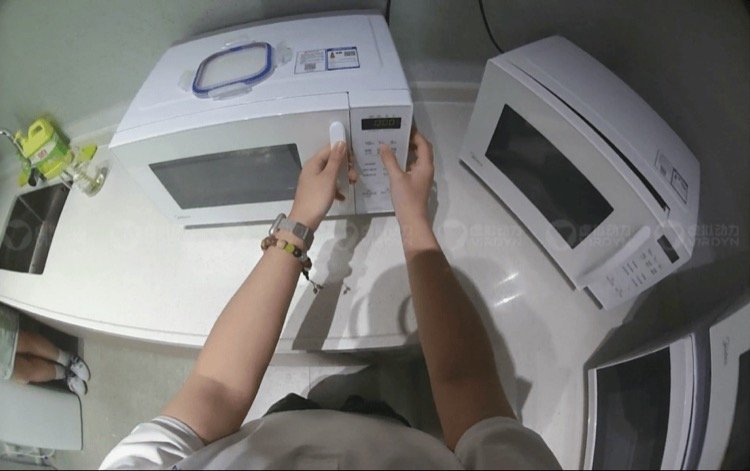
What Public Research Reveals About Dataset Design
Egocentric Data Requires More Than Video Volume
Ego4D describes a collection of 3,670 hours of daily-life video from 923 participants across 74 locations in nine countries.
Its documentation also describes multiple annotation tasks and additional modalities available for portions of the collection.
The practical lesson is that “hours recorded” does not fully describe a dataset. Buyers also need to understand task coverage, participant diversity, annotation availability, and which modalities actually accompany each recording.
Ego4D’s privacy documentation also makes consent and de-identification visible parts of the collection process.
Robotics Data Needs Standardization Across Sources
The Open X-Embodiment project describes more than one million real robot trajectories spanning 22 robot embodiments.
Its research highlights the importance of bringing heterogeneous robot datasets into consistent formats.
For commercial projects, the implication is straightforward: combining datasets requires more than merging folders. Teams must reconcile observation structures, action representations, task descriptions, and other compatibility requirements.
Standardization enables reuse, but it does not eliminate differences between robots or collection conditions.
A Practical Workflow for Choosing Labels and Annotations
1. Define the Model’s Required Output
Start with the deployment task.
“Improve robot intelligence” is too broad. “Identify whether a package was successfully placed in the correct bin” gives the data team a concrete target.
2. Build the Annotation Schema
List every required field, its meaning, allowed values, and unit of measurement.
For a manipulation episode, fields might include task instruction, object identity, action interval, outcome, and failure reason.
Distinguish directly recorded measurements from human judgments and algorithmically derived estimates.
3. Write Rules for Ambiguous Cases
Document occlusion, incomplete actions, uncertain objects, interrupted demonstrations, and failures.
Specify when annotators should select “unknown” rather than guess. A smaller amount of trustworthy supervision is often more useful than unsupported precision.
4. Run a Representative Pilot
Test the workflow on typical examples and difficult cases before scaling.
Review disagreements with the model team. Confirm that the output can be loaded by the actual training pipeline.
5. Scale With Targeted Review
Use automation where it performs reliably, but retain human review for uncertain predictions and difficult conditions.
Prioritize rare events, safety-relevant failures, and examples that expose weaknesses in the current model.
6. Validate the Delivery
Check file integrity, schema compliance, timestamps, annotation quality, and dataset splits.
Keep closely related recordings together when separating training and evaluation data, reducing the risk that near-duplicate examples inflate measured performance.
How to Measure Annotation Quality
A single “accuracy” percentage rarely explains the quality of a multimodal dataset.
Use metrics matched to the output:
| Data component | Useful quality check |
|---|---|
| Classification labels | Per-class precision, recall, and confusion analysis |
| Bounding boxes or masks | Intersection over Union against reviewed references |
| Keypoints | Position error with visibility rules |
| Object tracks | Identity switches and missing-track review |
| Action intervals | Boundary deviation or temporal overlap |
| Sensor streams | Timestamp alignment, missing samples, discontinuities |
| Language descriptions | Correctness, completeness, terminology consistency |
Agreement between annotators is useful, but agreement alone does not establish correctness. Reviewers may consistently apply an incorrect rule.
Combine representative expert review, automated validation, and downstream model evaluation. Define acceptance thresholds before production begins.
What Determines Data Annotation and Labeling Costs?
Pricing depends on the work required to produce accepted training examples.
Important factors include:
-
Annotation density per image or video.
-
Object count and scene complexity.
-
Specialist knowledge.
-
Temporal tracking requirements.
-
Sensor synchronization and calibration.
-
Review depth and rework.
-
Privacy processing and delivery requirements.
Compare cost per accepted sample, frame, or episode—not simply the lowest quoted unit price.
Also distinguish collection costs from annotation costs. Reusing an off-the-shelf dataset may reduce collection work, but unsuitable licensing, scene coverage, or output structures can create additional adaptation costs.
Synthetic data can supplement real recordings with controlled variations. It should still be evaluated against real-world conditions rather than assumed to remove the simulation-to-reality gap.
How Virdyn Supports AI Training Data Workflows
Virdyn, also known as VDEgo, describes an integrated offering covering first-person collection, multimodal dataset development, data processing, annotation, and delivery.
Its VDEgo-C2 binocular capture device is designed for egocentric recording. The company’s stated hardware capabilities include stereo RGB capture, synchronized IMU data, timestamps, pose tracking, local storage, and wireless control.
Its proposed data workflow spans requirement analysis, scene design, task planning, collection, cleaning, annotation, quality inspection, and delivery.
For prospective buyers, these capabilities should become measurable contractual requirements. Confirm which signals are recorded directly, which outputs require additional processing, and how each output will be validated.
MP4, AVI, CSV, JSON, and PLY can support delivery, but file extensions alone do not make data training-ready. Request a sample package with field definitions, units, coordinate conventions, and loading instructions.
Turn Your Training Objective Into a Clear Data Specification
The most useful question is not whether you need “annotation” or “labeling.” It is which supervision your model needs and how you will prove that the delivered data meets that requirement.
For an embodied AI or computer vision project, share your target tasks, collection environments, required modalities, and output schema with Virdyn. Request a representative pilot, a sample delivery package, and agreed acceptance criteria before committing to full-scale production.

Frequently Asked Questions
Are data annotation and data labeling the same?
They often mean the same thing in commercial practice. Some teams distinguish simple category assignment from richer annotation, but there is no universally enforced boundary.
Is data annotation always more expensive?
No. A specialist classification task can cost more than straightforward spatial annotation. Compare complexity, expertise, review requirements, and accepted output quality.
Can AI automate data labeling?
AI can generate preliminary labels and annotations. Human review remains important for ambiguous cases, unfamiliar conditions, and errors that automated confidence scores may not reveal.
What annotations do first-person robotics videos need?
Requirements depend on the objective. They may include hand keypoints, object tracks, action intervals, language descriptions, and outcomes. Robot control targets require separate consideration.
Should I choose an off-the-shelf or custom dataset?
Choose an off-the-shelf dataset when its coverage, license, modalities, and schema fit the task. Choose custom collection when deployment conditions or required interactions are insufficiently represented.
How should synthetic and real-world data be combined?
Use synthetic data for targeted variation and controlled scenarios, then evaluate performance on representative real recordings. Document which examples are synthetic and avoid assuming both domains are interchangeable.
References
1. iMerit — “Data Annotation vs Data Labeling: What’s the Difference?” Comparative industry framing; terminology is treated here as overlapping rather than universally distinct. https://imerit.ai/resources/blog/data-annotation-vs-data-labeling-whats-the-difference/
2. Amazon Web Services — “What Is Data Labeling?” Definitions and examples showing that labeling includes images, pixels, keypoints, and bounding boxes. https://aws.amazon.com/what-is/data-labeling/
3. Amazon SageMaker AI Documentation — “Classify Image Objects Using a Bounding Box.” Technical example of spatial annotation described as a labeling job. https://docs.aws.amazon.com/sagemaker/latest/dg/sms-bounding-box.html
4. Ego4D — Official project overview. Source for collection size, participants, locations, and research scope. https://ego4d-data.org/
5. Ego4D — Official documentation. Source for multimodal availability and benchmark annotations. https://ego4d-data.org/docs/
6. Ego4D — “Privacy and Ethics.” Source for consent and de-identification practices. https://ego4d-data.org/docs/privacy/
7. Open X-Embodiment — “Robotic Learning Datasets and RT-X Models.” Research paper describing robot trajectories, embodiments, and dataset standardization. https://robotics-transformer-x.github.io/paper.pdf
8. Amazon Web Services — “Build an Active Learning Pipeline for Automatic Annotation of Images with AWS Services.” Example of combining automated annotation with human labeling. https://aws.amazon.com/blogs/machine-learning/build-an-active-learning-pipeline-for-automatic-annotation-of-images-with-aws-services/
Hot Tags: Data Annotation Services, Data Labeling Services, AI Training Data, Computer Vision Annotation, Multimodal Data Collection, Egocentric Data Collection, Robotics Training Data, Custom Dataset Development, Image Annotation Services, Video Annotation Services
SHARE



