Powering Physical AI with Real-World Ego Datasets

AI-Assisted vs Manual Annotation for Robotics Datasets
Content Menu
● Why Robotics Data Annotation Requires More Than Object Labels
>> Human Demonstrations Are Not Automatically Robot Actions
● What Is AI-Assisted Data Labeling?
>> Where Model Assistance Creates Value
>> Where Human Judgment Matters Most
● AI-Assisted Data Labeling vs Manual Annotation: Comparison Table
● Comparing Annotation Accuracy, Consistency, and Risk
>> Visual Accuracy Is Only One Quality Dimension
>> Automation Can Multiply Systematic Errors
● Compare Total Cost, Not the Cheapest Label
>> A Practical Break-Even Test
● What Public Robotics Datasets Teach Us About Scale
● A Practical Human-in-the-Loop Annotation Workflow
>> 1. Define the Training Objective and Label Schema
>> 2. Validate the Captured Data
>> 3. Build an Independently Reviewed Reference Set
>> 4. Apply Assistance Selectively
>> 5. Route Difficult Cases to People
>> 6. Release Versioned, Auditable Deliverables
● Three Overlooked Decisions That Improve Robotics Dataset Quality
>> Separate Observable Events From Inferred Physical States
>> Prevent Leakage Between Training and Evaluation
>> Preserve Useful Failures and Recoveries
● Applying This Framework to Virdyn’s Data Services
>> Specify the Deliverable Beyond File Extensions
>> Keep Real and Simulated Data Traceable
● Conclusion: Choose the Workflow Your Evidence Supports
>> 1. Is AI-assisted data labeling always faster than manual annotation?
>> 2. Can manual annotation guarantee accurate robotics training data?
>> 3. Which robotics annotations are suitable for automation?
>> 4. Do VLA datasets require robot action measurements?
>> 5. How should teams evaluate an annotation provider?
>> 6. Can simulation replace real-world data collection?
AI-assisted data labeling vs manual annotation for large robotics datasets is a decision about more than annotation speed. It determines how reliably a robot can connect visual observations with instructions, movements, and physical outcomes. For teams developing embodied AI, Vision-Language-Action (VLA) models, or world models, the practical answer is usually hybrid: automate repeatable labeling work while keeping people responsible for ambiguous interactions, task definitions, and quality acceptance.
My recommendation is to compare workflows by the cost of producing accepted, training-ready episodes—not by the number of labels generated per hour. A fast pipeline has limited value if its outputs require extensive correction or hide systematic errors.
This guide compares both approaches and explains how to build a scalable workflow around real-world, multimodal robotics data.
Why Robotics Data Annotation Requires More Than Object Labels
A conventional image annotation project might identify a cup, hand, or storage bin. Robotics datasets often need to explain how those objects interact over time.
Consider a demonstration of someone placing a component into a fixture. Useful annotations may include:
-
Object identities and segmentation masks.
-
Hand positions and object trajectories.
-
The start and end of each manipulation step.
-
Contact, release, failure, and recovery events.
-
Language instructions describing the intended task.
-
Episode outcomes and data-quality flags.
These labels must remain consistent with video, timestamps, and available sensor measurements.
However, not every robotics dataset needs every annotation type. A segmentation project and a robot imitation-learning project require different deliverables. Define the training objective before choosing the labeling workflow.
Human Demonstrations Are Not Automatically Robot Actions
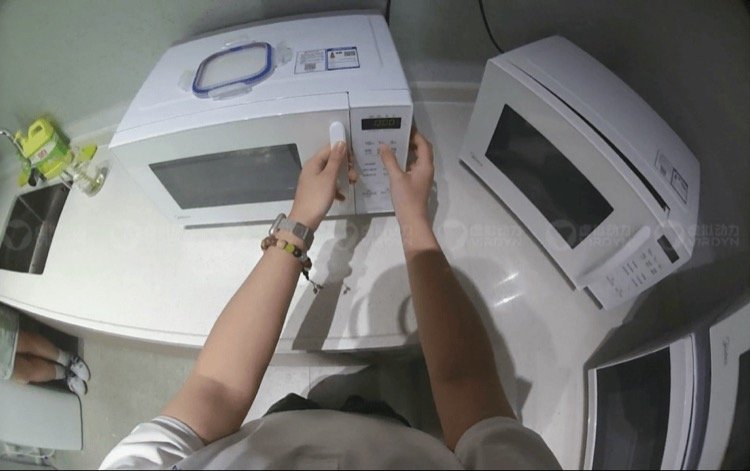
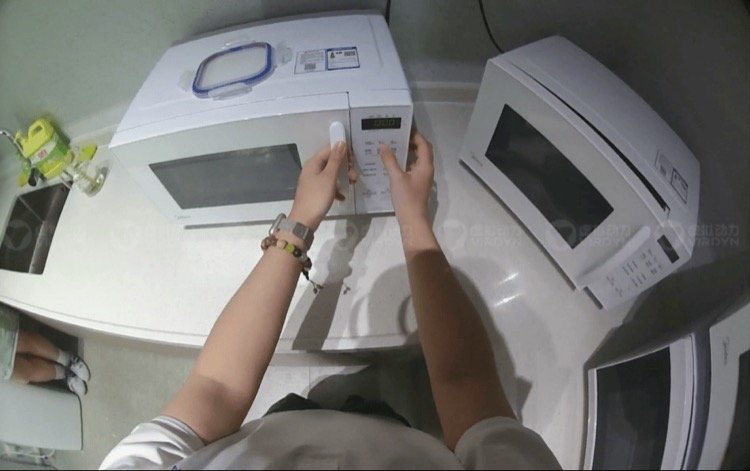
Egocentric recordings show how people manipulate their surroundings. They do not automatically provide robot joint commands, gripper forces, or executable action trajectories.
Similarly, an object mask identifies visible pixels; it does not prove that a stable grasp occurred.
This distinction matters when developing datasets for VLA models. Human demonstration data may support representation learning or task understanding, while direct robot policy training can require additional robot-specific observations, action records, or a validated mapping between embodiments.
What Is AI-Assisted Data Labeling?
AI-assisted data labeling uses models to propose annotations that people review, correct, or approve.
For large robotics datasets, assistance can include:
-
Generating object boxes and segmentation masks.
-
Propagating object tracks across video frames.
-
Suggesting task descriptions.
-
Proposing action boundaries.
-
Flagging missing data or unusual sequences.
The model supplies a starting point rather than an unquestionable answer.
For example, an annotator might identify a tool in one frame, allow a segmentation model to track it, and correct the track when a hand obscures it.
Where Model Assistance Creates Value
The strongest opportunities involve repetitive structures: recurring objects, stable camera conditions, and clearly defined visual categories.
Video segmentation research provides a useful example. The SAM 2 paper reported an 8.4-fold annotation speed improvement over its earlier model-assisted phase at comparable quality.
That result demonstrates potential, not a universal robotics benchmark. It does not establish equivalent gains for contact labeling, language annotation, or multimodal synchronization.
What Is Manual Annotation?
Manual annotation places human judgment at the center of label creation. Annotators inspect recordings, interpret task rules, and create labels without relying primarily on model-generated proposals.
They may still use software tools, interpolation, and synchronized playback. “Manual” does not necessarily mean drawing every shape independently on every frame.
Where Human Judgment Matters Most
Manual work is particularly valuable when:
-
The annotation taxonomy is still developing.
-
Objects or environments are unfamiliar.
-
Interactions involve heavy occlusion.
-
Task success depends on subtle contextual evidence.
-
Specialists must distinguish acceptable operations from procedural errors.
For example, placing a part inside a fixture may look successful while leaving it incorrectly oriented. Whether the available recording can establish that error depends on camera coverage, task rules, and supporting measurements.
Humans also make mistakes. Expertise, clear instructions, and independent review remain necessary.
AI-Assisted Data Labeling vs Manual Annotation: Comparison Table
| Dimension | AI-assisted labeling | Manual annotation |
|---|---|---|
| Initial setup | Requires model selection, integration, and validation | Requires guidelines, training, and tooling |
| Throughput | Strong potential for repetitive visual tasks | More dependent on annotator capacity |
| New environments | May require adaptation and closer review | Can adapt through updated instructions |
| Consistency | Can repeat the same rule—or mistake—at scale | Can vary between annotators |
| Complex interactions | Useful proposals, but interpretation needs validation | Better suited to contextual adjudication |
| Temporal labeling | Can propagate tracks efficiently | Useful for verifying critical transitions |
| Cost structure | Setup, inference, review, and correction | Labor, supervision, review, and correction |
| Best application | Stable, high-volume labeling tasks | Novel, ambiguous, or specialist tasks |
Neither method guarantees quality. The important question is which workflow reaches your acceptance criteria with the least total effort.
Comparing Annotation Accuracy, Consistency, and Risk
Visual Accuracy Is Only One Quality Dimension
A dataset can contain accurate object boundaries but incorrect task descriptions.
Evaluate quality separately for:
-
Spatial accuracy: Are boxes, masks, and keypoints correct?
-
Temporal accuracy: Do event boundaries match the recorded interaction?
-
Semantic accuracy: Do labels describe the right objects and actions?
-
Cross-modal alignment: Do observations and sensor records correspond?
-
Outcome accuracy: Does the success label match the agreed definition?
Use task-specific metrics rather than one overall “accuracy” percentage.
Mask overlap, event-boundary error, and episode-outcome agreement measure different properties. None alone proves that a dataset will improve robot performance.
Automation Can Multiply Systematic Errors
A model might consistently confuse visually similar components or lose a transparent object against a reflective surface.
If reviewers trust plausible predictions too readily, these errors can spread through thousands of episodes.
Manual teams face a different risk: inconsistent interpretations. Two annotators may disagree about when “grasping” becomes “lifting.”
A strong workflow addresses both problems through explicit definitions, reference examples, disagreement tracking, and adjudication.

Compare Total Cost, Not the Cheapest Label
AI assistance reduces cost only when the time saved exceeds setup, inference, review, and correction overhead.
A useful evaluation framework is:
Cost per accepted episode=(setup + labeling + review + rework costs)/episodes meeting acceptance criteria
An episode is a complete recorded attempt at a task, using a project-defined start and end.
A Practical Break-Even Test
Suppose manual labeling takes ten minutes per episode. An assisted workflow takes two minutes to generate proposals and four minutes to review and correct them.
That creates a hypothetical four-minute saving before setup costs. It is an illustrative scenario, not a measured industry result.
If difficult episodes require twelve minutes of correction, the advantage disappears for that category.
Benchmark separately across:
-
Straightforward demonstrations.
-
Occlusion-heavy interactions.
-
Rare objects and tools.
-
Failed attempts and recoveries.
-
New environments.
A single average can conceal the categories driving most rework.
What Public Robotics Datasets Teach Us About Scale
DROID provides a useful reference for real-world collection complexity. Its project documentation describes approximately 76,000 demonstration trajectories, 350 hours of interaction, 564 scenes, and 86 tasks.
Those figures illustrate why large robotics projects need more than a fast labeling interface. They need consistent episode organization, collection protocols, metadata, and interpretation across varied environments.
DROID does not establish that one annotation method universally outperforms another. Instead, it highlights the importance of evaluating workflows across realistic scene and task diversity.
A pilot based only on clean, repetitive footage may underestimate production difficulty.
A Practical Human-in-the-Loop Annotation Workflow
1. Define the Training Objective and Label Schema
Start with the intended use: perception, imitation learning, task evaluation, or multimodal representation learning.
Specify required labels, uncertainty categories, and acceptance criteria. Explain how to handle invisible objects and ambiguous outcomes.
2. Validate the Captured Data
Check recording integrity before annotation.
Review timestamps, dropped frames, camera calibration where relevant, and synchronization between available streams. Labeling cannot repair missing evidence or establish physical measurements that were never captured.
3. Build an Independently Reviewed Reference Set
Select representative episodes covering ordinary tasks and difficult conditions.
Have trained annotators label them, then resolve disagreements through expert review. Keep an evaluation subset separate from model tuning.
4. Apply Assistance Selectively
Use model proposals where the reference-set evaluation supports them.
Automate straightforward object tracking before attempting more interpretive labels such as task success. Introduce assistance by label type rather than switching the entire project at once.
5. Route Difficult Cases to People
Prioritize uncertain predictions, unfamiliar scenes, tracking failures, and disputed outcomes.
Do not rely exclusively on confidence scores. Also inspect a random sample of apparently reliable outputs, because confidently wrong predictions can escape uncertainty-based routing.
6. Release Versioned, Auditable Deliverables
Record label definitions, annotation revisions, review status, and known limitations.
Check that exported identifiers and timestamps remain consistent across video, annotations, and sensor files.
Three Overlooked Decisions That Improve Robotics Dataset Quality
Separate Observable Events From Inferred Physical States
“Hand touches object” and “object is securely grasped” are not equivalent labels.
The first may be visually observable. The second may require additional viewpoints, motion evidence, or force measurements.
Allow “uncertain” or “not observable” where appropriate. Forcing a definite answer can turn missing evidence into misleading supervision.
Prevent Leakage Between Training and Evaluation
Adjacent frames from one demonstration are highly related. Splitting them randomly across training and evaluation can make results appear stronger than performance on genuinely unfamiliar demonstrations.
Choose splits that reflect deployment goals: episodes, operators, environments, objects, or recording sessions.
Evaluate annotation tools and downstream models with those distinctions in mind.
Preserve Useful Failures and Recoveries
An unsuccessful demonstration is not automatically worthless.
Failure and recovery sequences can support outcome prediction, error detection, and recovery research. Whether they belong in a policy-training subset depends on the training objective.
Label outcomes explicitly instead of deleting every unsuccessful episode or mixing all outcomes without distinction.
Applying This Framework to Virdyn’s Data Services
Virdyn’s supplied company profile describes an end-to-end offering spanning requirements analysis, scenario design, egocentric capture, processing, annotation, quality inspection, and delivery.
Its VDEgo-C2 is described as a binocular first-person capture device supporting RGB video, synchronized IMU data, timestamps, and related collection functions.
For prospective customers, the key is to translate those capabilities into a project-specific acceptance plan.
Specify the Deliverable Beyond File Extensions
MP4, AVI, CSV, JSON, and PLY identify containers or file formats. They do not, by themselves, define a training-ready dataset.
A useful specification should also cover:
-
Sensor availability and synchronization checks.
-
Calibration records where required.
-
Coordinate systems and measurement units.
-
Episode identifiers and task definitions.
-
Annotation schemas and review status.
-
Privacy handling, permissions, and retention.
-
Training-loader compatibility.
Camera pose, three-dimensional information, and hand-motion outputs should be verified individually, including whether they are directly measured or computationally estimated.
Keep Real and Simulated Data Traceable
Virdyn’s profile also describes combining real-world collection with simulation.
Simulated labels can supplement real recordings, but their usefulness must be tested against the intended real-world task. Keep source provenance visible so teams can evaluate each contribution.
The company capabilities discussed here come from the supplied brief, not independently verified performance testing.
Conclusion: Choose the Workflow Your Evidence Supports
For large robotics datasets, AI-assisted labeling is strongest when tasks are repeatable and predictions are easy to verify. Manual annotation remains important for new schemas, ambiguous interactions, and expert decisions.
The most defensible approach combines both, with acceptance criteria established before scaling.
For a Virdyn project, request a representative pilot comparing manual and assisted workflows on the same episodes. Require correction time, label-specific quality results, synchronization checks, and cost per accepted episode before committing to production volume.

Frequently Asked Questions
1. Is AI-assisted data labeling always faster than manual annotation?
No. Poor predictions can create more correction work than they save. Test the complete workflow, including review and rework, on representative recordings.
2. Can manual annotation guarantee accurate robotics training data?
No. Human interpretation varies. Clear guidelines, training, independent review, and adjudication are necessary to control inconsistency.
3. Which robotics annotations are suitable for automation?
Repeated object detection, segmentation, and tracking are practical candidates. Validate performance on your objects, viewpoints, and environments before expanding automation.
4. Do VLA datasets require robot action measurements?
The requirement depends on the training objective. Human video can support some learning stages, but it does not inherently contain robot-specific action targets.
5. How should teams evaluate an annotation provider?
Compare accepted output quality, correction effort, temporal consistency, schema clarity, security controls, and export compatibility—not just headline annotation prices.
6. Can simulation replace real-world data collection?
Not by assumption. Evaluate the resulting model on representative real-world tasks and retain provenance so the contribution of simulated data remains measurable.
References
1. Ravi, N., et al. “SAM 2: Segment Anything in Images and Videos.” Research paper describing model-assisted video segmentation, its annotation data engine, and the reported 8.4-fold efficiency improvement against an earlier assisted phase. https://arxiv.org/html/2408.00714
2. DROID research team. “DROID: A Large-Scale In-the-Wild Robot Manipulation Dataset.” Official project page documenting dataset scale, scene diversity, tasks, and collection details. https://droid-dataset.github.io/
3. Seeed Studio. “Data Quality: Structure, Synchronization & Validation.” Practical documentation covering robotics dataset organization, timestamp alignment, recording integrity, and demonstration checks. https://wiki.seeedstudio.com/robotics/hands_on_dataset_quality/
4. Voxel51. “LeRobot Datasets in Voxel51: Visualize, Search, and Curate.” Technical discussion of synchronized inspection across camera streams, robot states, actions, and annotations. https://voxel51.com/blog/lerobot-dataset-support-voxel51
Hot Tags: AI Data Annotation, Data Labeling Services, Robotics Training Data, AI-Assisted Data Labeling, Manual Data Annotation, Robotics Dataset Annotation, Egocentric Data Collection, Multimodal Datasets, Embodied AI Training Data, Custom AI Datasets
SHARE



