Powering Physical AI with Real-World Ego Datasets


Data Annotation Challenges and Solutions for Embodied AI
Content Menu
● Why Data Annotation Challenges Are Different for Embodied AI
● 1. Inconsistent Labels and Unclear Annotation Guidelines
>> How to Improve Annotation Consistency
● 2. Domain Expertise Without an Unmanageable Review Cost
>> Use Experts Where Their Judgment Matters Most
● 3. Multimodal Synchronization and Calibration Errors
>> Treat Synchronization as a Separate Quality Gate
● 4. Subjectivity, Bias, and Incomplete Scenario Coverage
>> Build a Coverage Matrix Before Collecting More Hours
● 5. Human Demonstrations Do Not Directly Define Robot Actions
>> Separate Perception Labels From Action Supervision
● 6. Privacy Risks in First-Person Data Collection
>> Design Privacy Controls Into the Workflow
● 7. Scaling Annotation Without Scaling Rework
>> Measure Accepted Output, Not Just Annotation Speed
● 8. Real and Synthetic Data Need Different Validation
● A Practical Data Annotation Workflow: From Brief to Delivery
>> Step 1: Define the Training Objective
>> Step 2: Design Scenarios and Tasks
>> Step 3: Capture and Inspect a Pilot
>> Step 4: Annotate, Review, and Revise
>> Step 5: Validate the Delivery Package
● How Virdyn Supports Egocentric AI Data Projects
>> Start With a Pilot You Can Evaluate
>> What Are the Biggest Data Annotation Challenges for Embodied AI?
>> How Can Teams Improve Data Annotation Quality?
>> Is Egocentric Video Enough to Train a VLA Model?
>> What Should a Multimodal Dataset Delivery Include?
>> Can Synthetic Data Replace Real-World Collection?
>> How Should a Company Evaluate an Annotation Provider?
Data annotation challenges become more demanding when artificial intelligence must understand and act in the physical world. For embodied AI, robotics, and computer vision teams, identifying objects is only the beginning. Training data may also need to explain what happened, when it happened, how objects moved, and whether an interaction succeeded.
A mislabeled object can weaken perception. A mistimed action boundary or misaligned sensor stream can create a different problem: an incorrect relationship between observation and movement.
The practical priority is traceability. Every delivered label should connect to a clear definition, a review process, and the original evidence. This guide explains how to build that foundation, resolve common annotation problems, and prepare multimodal datasets for meaningful model evaluation.

Why Data Annotation Challenges Are Different for Embodied AI
Traditional image annotation often focuses on individual frames. Embodied AI introduces continuous interactions involving people, objects, environments, and potentially robot controls.
Consider someone picking a component from a warehouse bin. Useful annotations might include:
-
The object’s identity and visible location.
-
The hand approaching and contacting it.
-
The beginning and end of the grasp.
-
Occlusion during manipulation.
-
The final placement and task outcome.
First-person video provides a valuable view of these interactions. Ego4D’s published dataset, for example, contains 3,670 hours of daily-life video spanning diverse environments and activities. Its benchmarks demonstrate that egocentric understanding extends beyond object detection into temporal and interaction-based tasks.
However, human video is not automatically robot-control data. Vision-language-action models may also require action representations, robot observations, or an explicit method for connecting human demonstrations to a particular embodiment.
That distinction should shape the collection plan before annotation begins.
1. Inconsistent Labels and Unclear Annotation Guidelines
One of the most common data annotation challenges is inconsistent interpretation.
Two annotators may agree that a person picked up a cup but disagree about when the action began. One selects initial hand movement. Another selects physical contact. Both interpretations are understandable unless the project defines the boundary.
How to Improve Annotation Consistency
Create an annotation specification that includes:
-
Label definitions and exclusions.
-
Positive examples and counterexamples.
-
Rules for temporal boundaries.
-
Instructions for occluded or ambiguous events.
-
An escalation process for unresolved cases.
For manipulation tasks, separate intention, contact, movement, and outcome rather than compressing everything into a vague “interaction” label.
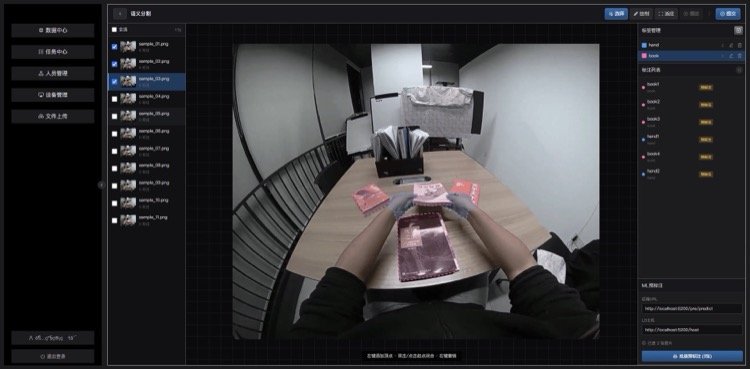
Run a calibration batch before scaling. Ask multiple annotators to label the same examples independently, then review disagreements with the project lead.
The objective is not simply to force agreement. It is to discover where the instructions fail to support a reproducible decision.
2. Domain Expertise Without an Unmanageable Review Cost
Specialized environments require specialized judgment.
An annotator may recognize that a worker inserted a component without knowing whether its orientation was correct. In industrial automation, laboratory workflows, and professional service environments, that difference can determine whether the demonstration represents success or failure.
The original iMerit article appropriately identifies subject-matter expertise as a central annotation challenge, particularly when labels depend on knowledge beyond visible appearance.
Use Experts Where Their Judgment Matters Most
A practical review structure separates routine work from consequential interpretation:
| Review layer | Primary responsibility | Typical examples |
|---|---|---|
| Trained annotators | Apply established rules | Object boxes, visible action segments |
| Senior reviewers | Resolve procedural inconsistencies | Boundary disputes, missing labels |
| Domain specialists | Validate technical meaning | Assembly correctness, safety-critical outcomes |
Experts should help define the taxonomy, approve reference examples, and adjudicate difficult cases.
This concentrates specialist attention on decisions that require it while allowing trained teams to handle repeatable work under documented guidance.
3. Multimodal Synchronization and Calibration Errors
Correct labels can still become unusable when their supporting sensor streams are misaligned.
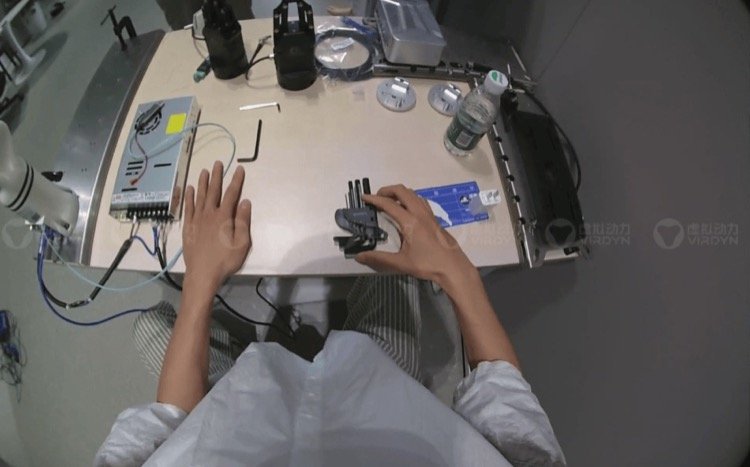
An egocentric dataset might combine stereo RGB video, IMU measurements, timestamps, camera poses, and derived hand trajectories. These streams must describe a compatible timeline and coordinate system.
For example, a contact label attached to the wrong moment may pair a pre-contact image with a post-contact movement estimate.
Treat Synchronization as a Separate Quality Gate
Before annotation, verify:
-
Timestamp units and clock sources.
-
Frame ordering and missing-frame behavior.
-
Sensor sampling rates.
-
Camera calibration records.
-
Coordinate conventions and measurement units.
-
Whether alignment uses hardware timing, software matching, or interpolation.
Do not interpret a “synchronized” label as proof of zero timing error. Define acceptable tolerances around the task’s requirements and verify them during the pilot.
A useful release package includes calibration files and synchronization notes alongside annotations, making downstream diagnosis possible.
4. Subjectivity, Bias, and Incomplete Scenario Coverage
Annotation bias and collection bias are related but distinct.
Annotation bias concerns how people interpret evidence. Collection bias concerns which evidence enters the dataset.
A perfectly labeled dataset can still offer narrow coverage if it repeatedly captures the same operator, room, object arrangement, and lighting.
Build a Coverage Matrix Before Collecting More Hours
Organize collection around meaningful variation:
| Dimension | Example variations |
|---|---|
| Environment | Warehouse, home, retail counter, laboratory |
| Objects | Different sizes, materials, packaging, orientations |
| Operators | Different movement styles and permitted task approaches |
| Visibility | Occlusion, clutter, changing illumination |
| Outcomes | Success, failed attempts, recovery, interruption |
Treat this matrix as a planning tool rather than proof of representativeness.
For evaluation, consider holding out entire operators, sessions, or environments. Randomly splitting neighboring frames can leave highly similar observations across training and test sets.
The essential question is whether evaluation measures generalization to unfamiliar conditions or recognition of familiar footage.
5. Human Demonstrations Do Not Directly Define Robot Actions
Egocentric data can show what a person sees and how a task unfolds. It does not necessarily contain the robot-specific commands needed to reproduce that task.
Hands, grippers, and robot arms differ in geometry, reach, actuation, and contact behavior.
Open X-Embodiment addresses a related challenge by bringing together real-robot experience across 22 embodiments and publishing standardized data resources. Its project documentation also distinguishes observations from explicit robot action representations.
Separate Perception Labels From Action Supervision
Define which layer each dataset supports:
-
Perception: objects, hands, poses, scene structure.
-
Task understanding: instructions, subtasks, outcomes.
-
Motion understanding: trajectories and interaction sequences.
-
Robot control: actions expressed for a specified robot interface.
For VLA development, agree on the action representation before promising training-ready delivery.
For world-model development, document observation sequences, temporal spacing, and available conditioning signals.
Clear scope prevents a common procurement mistake: purchasing useful video while expecting a complete robot-control dataset.
6. Privacy Risks in First-Person Data Collection
Wearable cameras can capture information outside the intended task.
Potential exposures include faces, screens, customer records, access badges, addresses, and confidential manufacturing processes.
Ego4D’s published collection methodology illustrates the importance of participant consent, institutional review where relevant, and de-identification procedures. These are operational requirements, not merely release-stage edits.
Design Privacy Controls Into the Workflow
Before recording:
-
Define permitted locations and prohibited content.
-
Establish participation and consent procedures appropriate to the context.
-
Remove sensitive documents and unnecessary screens.
-
Specify access permissions and approved processing locations.
-
Agree on retention, deletion, and incident handling.
After recording, review both raw footage and derived outputs.
Blurring a face does not automatically remove every identifying detail. Likewise, local storage does not by itself establish secure handling or legal compliance.
Privacy decisions should reflect the jurisdiction, setting, participants, and intended use.
7. Scaling Annotation Without Scaling Rework
Automation can assist with initial detections, segmentation proposals, and candidate action boundaries. However, model-generated suggestions should remain subject to validation.
The practical risk is accepting plausible-looking labels without checking the failure cases most relevant to the application.
Measure Accepted Output, Not Just Annotation Speed
Track complementary indicators:
-
Acceptance rate after review.
-
Rework frequency by label category.
-
Unresolved ambiguity rate.
-
Critical-error frequency.
-
Performance across difficult scenario groups.
Use metrics suited to the task. Spatial overlap, temporal-boundary agreement, and categorical agreement measure different things.
Set acceptance criteria during the pilot rather than borrowing a universal accuracy target.
NIST’s AI Risk Management Framework supports documenting evaluation methods, dataset characteristics, and relevant risks throughout the system lifecycle. It does not prescribe one annotation threshold for every application.
8. Real and Synthetic Data Need Different Validation
Simulation can expand controlled variation and generate annotations that would be expensive to produce manually.
However, synthetic data should not be assumed equivalent to real-world observations. Visual appearance, object behavior, contact dynamics, and sensor characteristics may differ.
Keep Data Origins Visible
A practical hybrid workflow is to:
-
Collect real examples of the target task.
-
Identify missing scenarios and difficult conditions.
-
Generate selected variations in simulation.
-
Preserve real-versus-synthetic provenance.
-
Evaluate on separately collected real-world data.
Record simulator versions and important generation parameters.
Where possible, compare real-only and mixed-data training under the same evaluation conditions. This tests whether synthetic additions help the intended application rather than merely increasing dataset volume.
A Practical Data Annotation Workflow: From Brief to Delivery
The strongest workflow connects collection decisions to measurable acceptance criteria.
Step 1: Define the Training Objective
Specify whether the dataset supports perception, task understanding, action learning, or another purpose.
List required modalities, labels, deployment conditions, and exclusions.
Step 2: Design Scenarios and Tasks
Create task scripts and a coverage matrix. Include expected failures and recovery behavior where relevant.
Step 3: Capture and Inspect a Pilot
Check visibility, synchronization, calibration, privacy exposure, and annotation feasibility before expanding collection.
Step 4: Annotate, Review, and Revise
Use the pilot to refine guidelines. Maintain versioned instructions and adjudicated examples.
Step 5: Validate the Delivery Package
Confirm that files open, timestamps align, schemas validate, and sample episodes load into the customer’s pipeline.
Common containers such as MP4, AVI, CSV, JSON, and PLY do not guarantee interoperability. The delivery also needs documented field meanings, units, coordinate frames, and missing-value conventions.
How Virdyn Supports Egocentric AI Data Projects
According to the supplied company information, Virdyn provides an end-to-end workflow covering requirements analysis, scenario design, task planning, first-person collection, processing, annotation, quality inspection, and delivery.
Its VDEgo-C2 wearable stereo camera is described as supporting binocular RGB capture, synchronized IMU data, timestamps, camera-pose tracking, local storage, and wireless remote control.
The proposed service scope includes:
-
Off-the-shelf and custom datasets.
-
Industry-specific collection environments.
-
Multimodal processing and annotation.
-
Real-world and simulation-based data production.
-
Hardware for customer-operated collection programs.
Buyers should confirm which signals are measured directly, estimated, or supplied through additional processing. They should also request sample outputs and project-specific validation evidence.
Start With a Pilot You Can Evaluate
Send Virdyn your target task, deployment environment, required modalities, annotation schema, and intended training pipeline.
Request a scoped pilot with a sample episode, documented processing steps, quality report, and acceptance checklist. Approve expansion only after the sample demonstrates that the data can support your intended use.
Frequently Asked Questions
What Are the Biggest Data Annotation Challenges for Embodied AI?
Key challenges include ambiguous action definitions, specialist interpretation, sensor misalignment, incomplete scenario coverage, privacy exposure, and the gap between human demonstrations and robot actions. Their importance depends on the model and deployment task.
How Can Teams Improve Data Annotation Quality?
Begin with clear definitions and a calibration batch. Combine appropriate automated checks with independent review, expert escalation, and task-specific acceptance criteria. Record guideline versions so changes remain traceable.
Is Egocentric Video Enough to Train a VLA Model?
Not necessarily. It can support visual and task understanding, but robot-action learning may require additional action supervision, robot observations, or an explicit mapping between human demonstrations and the target robot.
What Should a Multimodal Dataset Delivery Include?
Include agreed sensor streams, annotations, timestamps, calibration information, schema documentation, provenance, and quality results. Confirm compatibility using sample episodes before accepting the full delivery.
Can Synthetic Data Replace Real-World Collection?
Treat replacement as an application-specific hypothesis, not an assumption. Evaluate synthetic or mixed training data against held-out real observations and relevant deployment tasks before deciding its role.
How Should a Company Evaluate an Annotation Provider?
Request a representative pilot. Evaluate technical interpretation, difficult-case handling, privacy procedures, documentation, and pipeline compatibility—not simply quoted volume or turnaround time.
References
1. iMerit. “Top Data Annotation Challenges and How to Solve Them.” Source article covering expertise, subjectivity, consistency, and privacy. https://imerit.ai/resources/blog/top-data-annotation-challenges-and-how-to-solve-them/
2. Grauman, K., et al. “Ego4D: Around the World in 3,000 Hours of Egocentric Video.” CVPR, 2022. Research source for egocentric dataset scope, benchmarks, and collection safeguards. https://openaccess.thecvf.com/content/CVPR2022/papers/Grauman_Ego4D_Around_the_World_in_3000_Hours_of_Egocentric_Video_CVPR_2022_paper.pdf
3. Open X-Embodiment Collaboration. “Open X-Embodiment: Robotic Learning Datasets and RT-X Models.” Project documentation covering cross-embodiment data and robot action representations. https://robotics-transformer-x.github.io/
4. National Institute of Standards and Technology. “Artificial Intelligence Risk Management Framework (AI RMF 1.0).” January 2023. Framework supporting documented evaluation, dataset characteristics, and risk management. https://nvlpubs.nist.gov/nistpubs/ai/nist.ai.100-1.pdf
Hot Tags: Data Annotation Services, AI Data Collection, Data Labeling Services, AI Training Data, Computer Vision Annotation, Multimodal Datasets, Egocentric Data Collection, Robotics Training Data, Custom AI Datasets, Synthetic Data Generation
SHARE


