Powering Physical AI with Real-World Ego Datasets


Egocentric vs Third-Person Data for Physical AI: Which Is Better?
Content Menu
● What Is Egocentric Data in Physical AI?
● What Is Third-Person Data in Robotics?
● Egocentric Data vs Third-Person Data: Comparison Table
● Which Perspective Builds Better Physical AI Models?
>> Egocentric Data for Hand–Object Interaction
>> Third-Person Data for Whole-Body and Workspace Understanding
>> Hybrid Data for Tasks Requiring Both
● What Published Datasets Actually Tell Us
● The Overlooked Issue: Observation Is Not Action Supervision
● A Practical Experiment to Choose Your Data Mix
>> 1. Define the Deployment Task
>> 2. Capture Comparable Conditions
>> 3. Prevent Evaluation Leakage
>> 4. Evaluate the Intended Outcome
>> 5. Compare Cost per Useful Result
● Data Quality Requirements for Both Perspectives
● How Virdyn Can Support an Embodied AI Data Strategy
● Build Around the Model’s Actual Learning Problem
>> Is egocentric data always better for robot manipulation?
>> Can third-person video train a physical AI model?
>> Does stereo video automatically provide accurate 3D ground truth?
>> What is the best ratio of first-person to third-person data?
>> Can human demonstrations replace robot trajectories?
>> What should a custom dataset delivery include?
Egocentric data vs third-person data is not a contest with one universal winner. First-person recordings reveal what an acting person sees during a task. Third-person recordings show how that person moves within the surrounding environment. For physical AI models, the better choice depends on what the system must perceive, predict, and control.
My starting point for evaluating a training dataset is therefore simple: alignment. Does the data expose the information the deployed model will actually need?
For close-range manipulation, egocentric data often provides a useful view of hands, tools, and objects. For whole-body movement and workspace relationships, third-person data offers a complementary perspective. Research such as Ego-Exo4D explicitly combines synchronized viewpoints to study skilled activities, rather than treating either perspective as sufficient for every task.
This comparison explains their practical differences, their limitations, and how to build a defensible data strategy for embodied AI.

What Is Egocentric Data in Physical AI?
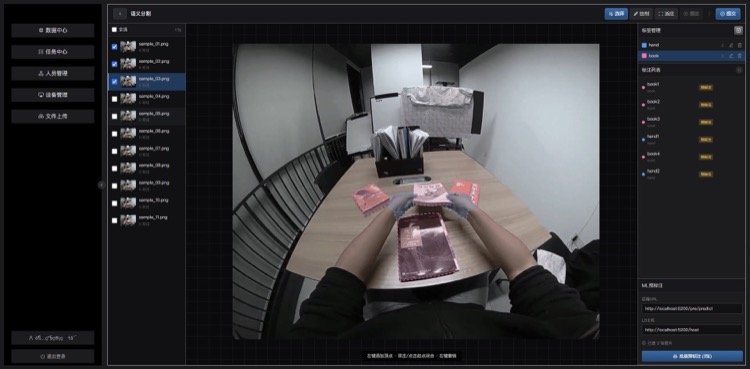
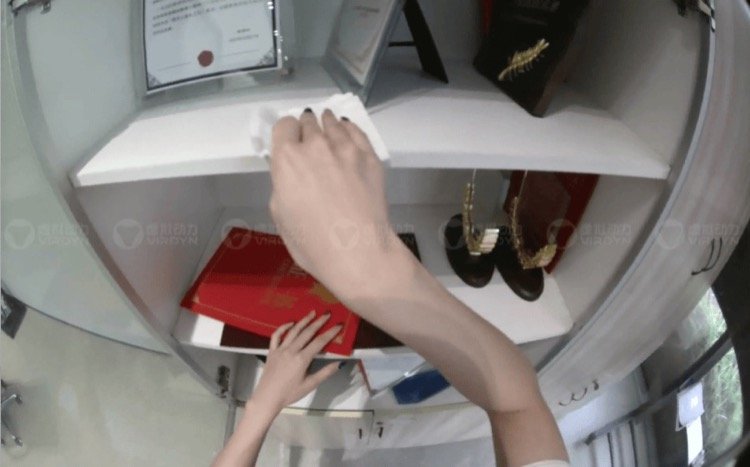
Egocentric data captures activity from a viewpoint associated with the person or agent performing it. In human demonstrations, cameras may be mounted on the head or body.
The resulting video records the task as it unfolds around the demonstrator: approaching a workstation, locating a component, reaching toward it, and completing an operation.
However, “egocentric” describes a viewpoint—not a guaranteed sensor package. A first-person recording does not automatically include depth, accurate hand poses, force measurements, or robot action labels.
Ego4D illustrates the breadth of this category. Its published dataset contains 3,670 hours of daily-life video across nine countries, with selected recordings accompanied by additional modalities such as audio, gaze, stereo, and environmental information. These modalities are not uniformly available for every recording.
For procurement, the important question is not simply whether footage is first-person. It is which signals, annotations, and calibration records accompany it.
What Is Third-Person Data in Robotics?
Third-person data, also called exocentric data, captures an actor from an external viewpoint. Cameras may observe a workstation, room, production line, or training area.
This perspective can expose relationships that a wearable camera misses: body posture, walking paths, surrounding equipment, and interactions between people.
Third-person does not necessarily mean monocular or static. A collection system can use multiple external cameras to observe the same activity.
Ego-Exo4D demonstrates this approach through simultaneous egocentric and exocentric recordings, alongside multimodal measurements and annotations for skilled activity understanding, cross-view translation, and hand/body pose estimation.
The distinction is therefore primarily where observation occurs, not whether one category is inherently more advanced.
Egocentric Data vs Third-Person Data: Comparison Table
The table below is a practical selection framework, not a benchmark ranking. Its trade-offs depend on camera placement, resolution, calibration, and task design.
| Comparison factor | Egocentric data | Third-person data |
|---|---|---|
| Viewpoint | Moves with the wearer or acting agent | Observes the actor externally |
| Useful visual emphasis | Nearby objects and task interactions | Body movement and scene relationships |
| Manipulation visibility | Can capture detailed hand–object activity | May require closer or additional cameras |
| Whole-body visibility | Often incomplete | Usually easier to arrange |
| Occlusion pattern | Hands and objects may block each other | The actor may block the task |
| Camera motion | Often changes with the wearer | Can remain stable |
| Workspace coverage | Limited to the current view | Can cover a wider area |
| Deployment match | Potentially relevant to agent-mounted cameras | Potentially relevant to external-camera systems |
| Main annotation challenge | Motion, close interactions, changing visibility | Small objects, occlusion, cross-camera identity |
| Key limitation | Human viewpoint is not robot control supervision | External observation may miss contact details |
Neither column establishes training superiority. That requires evaluation on the intended model and deployment task.
Which Perspective Builds Better Physical AI Models?
Egocentric Data for Hand–Object Interaction
First-person data is a strong candidate when the learning problem centers on what happens near the acting person’s hands.
Consider assembling a connector. A useful demonstration might reveal how the worker approaches the part, adjusts orientation, and checks the result.
These are the kinds of interaction-centered questions reflected in Ego4D’s hand–object manipulation and activity forecasting benchmarks. Their inclusion establishes the relevance of first-person data to these research problems; it does not prove a universal advantage over external cameras.
When evaluating such footage, I would inspect actual task moments before reviewing headline recording hours. A large collection has limited value if fingers consistently obscure the connection point.
Third-Person Data for Whole-Body and Workspace Understanding
External views are worth prioritizing when the target behavior depends on relationships beyond the immediate manipulation area.
Examples include a worker moving between stations, two people coordinating a lift, or a mobile agent navigating around equipment.
The practical advantage is coverage: camera placement can be designed around the body and workspace rather than the wearer’s current orientation. Nevertheless, an external camera can still lose critical details behind an arm, tool, or machine.
Ego-Exo4D’s combination of external and wearable views provides a relevant research model for studying these complementary observations.
Hybrid Data for Tasks Requiring Both
For tasks involving local manipulation and wider spatial coordination, a synchronized hybrid pilot is often the most informative experiment.
The purpose is not simply to accumulate additional video. It is to connect corresponding observations: what the hands did, where the body moved, and how the environment changed at the same moment.
Ego-Exo4D supports research on these cross-view relationships. However, its existence should not be interpreted as proof that every hybrid dataset improves every downstream robot policy.
What Published Datasets Actually Tell Us
Three research examples help separate evidence from marketing assumptions.
| Research resource | Published scope | Relevant lesson |
|---|---|---|
| Ego4D | 3,670 hours of daily-life egocentric video | First-person data can cover diverse activities at scale |
| Ego-Exo4D | The cited paper reports 1,286 combined video hours from synchronized viewpoints | Paired perspectives enable cross-view research |
| Open X-Embodiment | More than one million robot trajectories across 22 embodiments | Robot experience remains important for learning executable behavior |
These figures come from the cited publications and should not be treated as equivalent units. Combined multiview video hours are not the same as unique task duration, and robot trajectories are not interchangeable with human video hours.
Open X-Embodiment also reports positive transfer across robot platforms. That supports the value of diverse robot training experience—not the claim that human first-person video alone produces reliable robot control.
The Overlooked Issue: Observation Is Not Action Supervision
A video can show a successful action without specifying how a robot should execute it.
The human demonstrator and target robot may differ in reach, joint structure, gripper geometry, sensing, and available controls. This makes “human-like viewpoint” an incomplete explanation of transfer quality.
Before commissioning data, distinguish three objectives:
-
Perception: identifying objects, states, and interactions.
-
Task understanding: recognizing steps, dependencies, and outcomes.
-
Control: selecting executable actions for a particular robot.
A collection may support the first two without providing sufficient supervision for the third.
Open X-Embodiment is useful context here because it contains robot trajectories rather than only observational human video. Its results highlight the importance of embodiment-specific experience within a broader training strategy.
For a VLA project, request a precise explanation of what counts as an “action” label. A task description, a human hand trajectory, and a robot control command are different deliverables.
A Practical Experiment to Choose Your Data Mix
Rather than selecting a universal egocentric-to-third-person ratio, I would recommend a controlled pilot.
1. Define the Deployment Task
Specify the target robot, sensors, operating environment, object range, and success criteria.
“Warehouse automation” is too broad. “Pick a specified carton from a shelf and place it upright in a tote” is testable.
2. Capture Comparable Conditions
Record equivalent tasks using:
-
Egocentric capture.
-
Third-person capture.
-
Synchronized combined capture.
Keep demonstrators, objects, instructions, and environmental variation comparable wherever possible.
3. Prevent Evaluation Leakage
Separate training and evaluation by meaningful factors such as operator, location, object instance, or recording session.
Adjacent clips from one demonstration should not create the illusion of generalization across genuinely new conditions.
4. Evaluate the Intended Outcome
For perception, assess the relevant recognition or localization task. For control, test task completion on the target robot.
Also track failure categories:
-
Missed objects.
-
Incorrect task ordering.
-
Poor grasp alignment.
-
Recovery failures.
-
Safety-related interventions.
5. Compare Cost per Useful Result
Include collection, calibration, annotation, rework, storage, and training costs.
The decision metric should reflect validated model improvement, not simply the lowest price per recorded hour. This pilot framework is a proposed evaluation method, not a claim of measured performance gains.
Data Quality Requirements for Both Perspectives
My recommended acceptance checklist would cover six areas:
-
Synchronization: document how video, IMU, and other streams share timestamps.
-
Calibration: deliver applicable camera intrinsics, extrinsics, and coordinate conventions.
-
Visibility: verify that task-critical objects and interactions remain observable.
-
Annotation consistency: define task boundaries, object identities, and failure labels.
-
Diversity: vary operators, layouts, objects, lighting, and execution outcomes deliberately.
-
Governance: document consent, permitted uses, access controls, and retention requirements.
Where 3D data is promised, clarify how it was produced. Stereo reconstruction, pose estimation, and directly measured geometry have different error characteristics.
Likewise, MP4, CSV, JSON, and PLY are delivery formats, not quality certifications. A usable dataset also needs schemas, units, identifiers, provenance, and documented limitations.
How Virdyn Can Support an Embodied AI Data Strategy
According to the company information supplied for this article, Virdyn (VDEgo) offers first-person data collection, multimodal dataset development, annotation, quality inspection, and data collection hardware.
Its stated VDEgo-C2 capabilities include stereo RGB capture, synchronized IMU data, timestamps, camera pose tracking, local storage, and wireless control. These are company-provided descriptions, not independently verified performance results.
A practical engagement should begin with the model’s requirements, then define:
-
Required sensor streams and calibration.
-
Task scenarios and collection protocols.
-
Annotation rules and acceptance samples.
-
Real-world versus simulated data provenance.
-
Delivery schemas and validation procedures.
Virdyn’s stated combination of real-world collection and simulation may support broader scenario planning. However, synthetic data should remain identifiable, and any claimed improvement should be validated on representative real-world tests.
Build Around the Model’s Actual Learning Problem
Choose egocentric data when first-person task observations address a demonstrated learning need. Choose third-person data when external spatial relationships matter. Test synchronized capture when both are necessary.
For a Virdyn project, prepare a brief specifying your target robot, deployment cameras, representative tasks, required modalities, and acceptance metrics. Request a small, auditable pilot before committing to production-scale collection.
Frequently Asked Questions
Is egocentric data always better for robot manipulation?
No. Its usefulness depends on whether the camera captures task-critical interactions and whether the resulting observations match the deployment problem. Robot control may still require additional action supervision.
Can third-person video train a physical AI model?
It can support relevant perception and activity-understanding research. Whether it supports reliable control depends on the labels, model, embodiment, and evaluation setup. Ego-Exo4D demonstrates research uses for external and paired viewpoints.
Does stereo video automatically provide accurate 3D ground truth?
No. Treat reconstructed geometry as a derived output with a documented method and validation process, rather than assuming that two cameras guarantee accurate measurements.
What is the best ratio of first-person to third-person data?
There is no ratio established by the evidence discussed here. Select a mix through comparable pilots and deployment-relevant evaluation rather than adopting a fixed percentage.
Can human demonstrations replace robot trajectories?
They should not be assumed to do so. Human observation and robot action experience provide different supervision. Open X-Embodiment demonstrates the value of large-scale robot trajectories and cross-platform training.
What should a custom dataset delivery include?
Request the agreed media and sensor streams, annotations, calibration, timestamp definitions, schemas, quality reports, usage permissions, and known limitations.
References
1. Grauman and colleagues. “Ego4D: Around the World in 3,000 Hours of Egocentric Video.” Published in 2022. Source for dataset scale, activity coverage, modalities, and benchmark objectives. https://experts.umn.edu/en/publications/ego4d-around-the-world-in-3000-hours-of-egocentric-video/
2. Grauman and colleagues. “Ego-Exo4D: Understanding Skilled Human Activity from First- and Third-Person Perspectives.” Source for synchronized viewpoints, multimodal recordings, dataset statistics, and research tasks. Figures in this article follow the cited paper version. https://arxiv.org/abs/2311.18259
3. Open X-Embodiment Collaboration. “Open X-Embodiment: Robotic Learning Datasets and RT-X Models.” Source for robot trajectory scale, embodiment coverage, and reported cross-platform transfer. https://arxiv.org/html/2310.08864v9
Hot Tags: AI Training Data, AI Data Collection Services, AI Data Annotation Services, Robotics Training Data, Embodied AI Datasets, Egocentric Data Collection, Multimodal Data Collection, Computer Vision Datasets, Custom AI Datasets, Physical AI Training Data.
SHARE



