Powering Physical AI with Real-World Ego Datasets


Data Annotation Quality Assurance for Embodied AI and Robotics
Content Menu
● Why Embodied AI Needs More Than Conventional Label Checks
>> First-Person Video Creates Distinct Challenges
>> Human Demonstrations Are Not Automatically Robot Actions
● Six Essential Data Annotation Quality Assurance Techniques
>> 1. Establish Task-Specific Annotation Guidelines
>> 2. Build an Expert-Adjudicated Gold Set
>> 3. Measure Agreement Without Confusing It With Truth
>> 4. Combine Representative and Risk-Based Sampling
>> 5. Use Automated Checks to Support Reviewers
>> 6. Close the Loop With Error Analysis
● Build Multimodal Quality Checks Before Annotation
>> Verify Capture and Synchronization
>> Validate Calibration and Coordinate Conventions
● A Practical Seven-Step Annotation Quality Workflow
>> Step 1: Translate the Training Objective Into Data Requirements
>> Step 2: Run a Representative Pilot
>> Step 3: Calibrate Annotators
>> Step 4: Approve Production Capture
>> Step 5: Apply Layered Review
>> Step 6: Test the Delivery Package
>> Step 7: Release With Versioned Evidence
● Measure Quality With a Dataset Acceptance Scorecard
● Worked Example: Warehouse Pick-and-Place Data
● Quality Assurance for Real and Synthetic Training Data
● How Virdyn Supports an Integrated Data Pipeline
● Build a Pilot Before Scaling Your Dataset
>> What is the difference between annotation quality assurance and quality control?
>> What accuracy level should a data annotation provider guarantee?
>> How do you evaluate temporal annotations?
>> Can automated annotation replace human reviewers?
>> Is first-person video sufficient for VLA training?
>> How should buyers compare data collection providers?
Data annotation quality assurance determines whether an AI dataset teaches a model useful behavior or reinforces costly mistakes. For embodied AI, the challenge extends beyond correct labels. Video, motion signals, camera geometry, action sequences, and task descriptions must describe the same physical event accurately and consistently.What Is Data Annotation Quality Assurance?
Data annotation quality assurance is the system of rules, training, checks, and corrective actions used to produce reliable labeled datasets.
It differs from a final inspection. Quality assurance establishes how work should be performed; quality control checks whether the resulting work meets those requirements.
For robotics and multimodal AI, both must cover:
1. Semantic accuracy: Do labels describe the visible objects and actions?
2. Temporal accuracy: Do action boundaries match the recorded event?
3. Spatial accuracy: Are boxes, masks, keypoints, and poses sufficiently precise?
4. Cross-modal consistency: Do associated sensor streams represent corresponding moments?
5. Dataset integrity: Are files, metadata, permissions, and versions complete?
A dataset can pass one category and fail another. Correct action names do not compensate for unusable timestamps.

Why Embodied AI Needs More Than Conventional Label Checks
Traditional annotation workflows often emphasize individual images or isolated labels. Embodied AI introduces continuous interactions, changing viewpoints, and dependencies between perception and action.
Consider someone opening a drawer. The sequence includes approaching, reaching, contacting the handle, pulling, and completing the state change.
A broad “open drawer” label may support activity recognition. A model learning manipulation may need finer boundaries, hand-object relationships, and evidence that the drawer actually opened.
First-Person Video Creates Distinct Challenges
Egocentric recordings can include rapid head movement, motion blur, occluded hands, and objects leaving the camera view.
Annotators must distinguish what is observable from what seems likely. A hand disappearing behind a container does not prove that a grasp occurred.
The annotation schema should therefore support uncertainty, partial visibility, and unobservable events rather than forcing confident guesses.
Human Demonstrations Are Not Automatically Robot Actions
Human first-person recordings can support visual understanding, action representation, and learning from demonstrations.
However, video and IMU data alone do not automatically provide robot joint commands, gripper forces, or executable control trajectories.
Buyers should distinguish observation datasets from robot-action datasets and specify any additional tracking, reconstruction, or embodiment-mapping requirements before collection begins.
Six Essential Data Annotation Quality Assurance Techniques
1. Establish Task-Specific Annotation Guidelines
Define the label taxonomy, inclusion rules, temporal boundaries, and uncertainty policy before production.
For a “pick up” action, clarify whether the interval begins at reaching, first contact, or object movement. Specify when the action ends and how failed attempts are represented.
Include examples, counterexamples, and difficult cases. Version the guidelines whenever definitions change.
2. Build an Expert-Adjudicated Gold Set
A gold set contains reference examples reviewed against agreed rules.
Use it to qualify annotators, evaluate ongoing performance, and identify categories that require retraining.
Include difficult examples alongside straightforward ones. A benchmark containing only clear, fully visible actions provides weak evidence of readiness for production.
Refresh affected examples when the ontology changes, while preserving earlier versions for auditability.
3. Measure Agreement Without Confusing It With Truth
Independent annotation helps reveal ambiguous instructions and inconsistent interpretations.
Choose agreement measures that match the task. Categorical labels may use chance-corrected agreement statistics; temporal segments may use overlap measures; object localization may use spatial overlap.
High agreement is not proof of correctness. Several annotators can share the same misunderstanding.
Escalate recurring disagreements to a qualified reviewer, then update the guidelines and revisit affected work.
4. Combine Representative and Risk-Based Sampling
Random sampling helps estimate quality across a production batch. Targeted sampling concentrates attention on higher-risk material.
Increase review coverage for:
1. Newly onboarded annotators.
2. Rare actions and unfamiliar environments.
3. Occluded hand-object interactions.
4. Failed tasks and recovery behavior.
5. Recently revised label categories.
Keep these sampling streams distinguishable. A deliberately difficult review sample should not be presented as an unbiased estimate of the entire dataset’s error rate.
5. Use Automated Checks to Support Reviewers
Automation can identify missing fields, invalid timestamps, impossible coordinates, duplicate identifiers, and broken file references.
Model-assisted checks can also flag unusual predictions or disagreements between labels and model outputs.
Treat those signals as review priorities, not automatic verdicts. A model may reject a valid rare example because its own training data lacked similar situations.
6. Close the Loop With Error Analysis
Record why annotations fail, not merely whether they fail.
Useful categories include misunderstood instructions, unclear source footage, timing ambiguity, tool problems, and reviewer inconsistency.
Correct the underlying cause, identify other affected records, and verify the rework. Otherwise, the same defect can recur across successive batches.
Build Multimodal Quality Checks Before Annotation
Annotation cannot recover information that was never captured correctly.
For egocentric data collection, establish recording acceptance criteria before operators enter the field.
Verify Capture and Synchronization
Check that required streams exist, decode correctly, and maintain expected timestamp behavior.
Assess dropped frames, discontinuities, and alignment between video and inertial measurements. Define acceptable synchronization error according to the intended learning task.
Avoid copying a universal tolerance into every project. Fast hand manipulation and broad activity recognition can impose different requirements.
Validate Calibration and Coordinate Conventions
When camera poses or three-dimensional information are required, document calibration methods, coordinate frames, measurement units, and transformation conventions.
Recheck calibration after changes that could affect geometry.
Public robotics datasets have released improved calibration information after their initial publication. The practical lesson is that geometry requires its own validation process, not simply a “calibrated” checkbox.
Check Coverage and Privacy
Monitor variation across operators, objects, environments, lighting, and task outcomes.
Repeated demonstrations from one convenient setup may inflate recording volume without providing equivalent diversity.
Also identify faces, screens, documents, and other sensitive information. Establish permission, redaction, access, and retention requirements before recording.
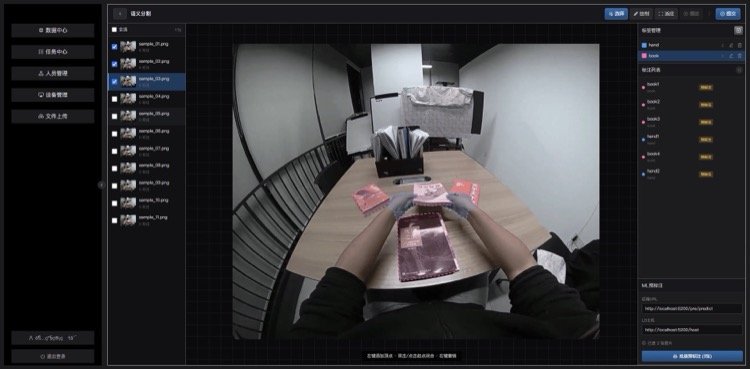
A Practical Seven-Step Annotation Quality Workflow
Step 1: Translate the Training Objective Into Data Requirements
Specify what the model must learn, which observations it needs, and which errors would undermine that objective.
Separate mandatory fields from optional enrichment.
Step 2: Run a Representative Pilot
Collect a small but varied sample that includes ordinary tasks, difficult visibility, failures, and relevant environmental variation.
Use the pilot to test capture procedures, annotation tools, and review effort before scaling.
Step 3: Calibrate Annotators
Have annotators label overlapping pilot material independently.
Review disagreements together. Publish clarified examples and require qualification against the revised reference set.
Step 4: Approve Production Capture
Validate recording completeness, synchronization, visibility, and required metadata before releasing sessions for annotation.
Reject or recollect unusable material early.
Step 5: Apply Layered Review
Combine automated validation, independent checks, representative sampling, and expert adjudication.
Increase scrutiny where errors are consequential or recurring rather than distributing review effort uniformly.
Step 6: Test the Delivery Package
Load a sample into the intended training pipeline.
Confirm that identifiers, timestamps, label mappings, and file references survive import correctly. Successful file transfer is not equivalent to successful training integration.
Step 7: Release With Versioned Evidence
Deliver the dataset alongside its schema, guidelines, quality report, known limitations, and change history.
Preserve a reproducible connection between released labels and source recordings.
Measure Quality With a Dataset Acceptance Scorecard
A single “accuracy” percentage rarely describes a complex multimodal dataset adequately.
Agree on separate acceptance measures:
| Quality dimension | Example measure | Acceptance consideration |
|---|---|---|
| Semantic labels | Per-class precision and recall | Protect rare, important classes |
| Temporal segments | Boundary error and temporal overlap | Match action granularity |
| Spatial annotations | Box or mask overlap | Account for small or occluded objects |
| Sensor alignment | Offset and drift checks | Match movement sensitivity |
| Completeness | Required-field coverage | Separate mandatory and optional fields |
| Delivery integrity | Schema and decoding checks | Confirm actual pipeline compatibility |
Thresholds should come from the pilot, intended model use, and error consequences—not an unsupported industry-wide promise.
Report results by meaningful slices, including task type, environment, and visibility condition. Strong averages can conceal weak performance on the examples that matter most.
Worked Example: Warehouse Pick-and-Place Data
Consider an illustrative project recording workers moving packages into storage bins. This is a proposed workflow, not a reported customer result.
A simple annotation scheme might label each clip “pick and place.” A more useful scheme could distinguish:
1. Reach toward the package.
2. Establish contact.
3. Lift the package.
4. Transport it.
5. Place it in the destination.
6. Release contact.
The review plan should examine package identity, destination identity, action boundaries, occlusion, and outcome.
If the worker drops the package and recovers it, preserve the failure and recovery sequence when relevant to the learning objective. Removing every imperfect attempt can eliminate useful behavioral variation.
For reliable evaluation, separate related recording sessions carefully across training and test sets. Near-duplicate scenes can make performance appear stronger than it is.
Quality Assurance for Real and Synthetic Training Data
Synthetic environments can expand controlled variation and generate annotations that would be expensive to obtain manually.
However, internally consistent simulator labels do not establish real-world suitability.
Review synthetic data for geometry, contact behavior, lighting, camera configuration, and task plausibility. Keep generation settings and provenance available.
For mixed datasets:
1. Align label definitions across real and simulated recordings.
2. Preserve source identifiers.
3. Evaluate performance separately on real examples.
4. Investigate failures by environment and task.
5. Adjust the mixture using measured results.
The objective is useful transfer, not simply a larger dataset.
How Virdyn Supports an Integrated Data Pipeline
Virdyn, through its VDEgo offering, describes an end-to-end service covering requirements analysis, scenario design, task planning, first-person capture, processing, annotation, inspection, and delivery.
Its stated applications include robotics, manufacturing, logistics, service environments, retail, and laboratory workflows.
The VDEgo-C2 is positioned for first-person capture with binocular RGB video and synchronized inertial data. Project requirements should establish which additional outputs—such as camera poses, spatial information, body motion, or hand-operation annotations—require separate processing or tracking.
Virdyn also describes off-the-shelf and custom dataset options, combining real-world collection with simulation capabilities.
For procurement, request a representative sample, schema, supported modality list, acceptance report, and documented limitations. MP4, AVI, CSV, JSON, and PLY are delivery containers; their presence alone does not establish training readiness.
Build a Pilot Before Scaling Your Dataset
Reliable data annotation quality assurance connects collection decisions, labeling rules, reviewer judgment, and downstream validation.
Before commissioning a large dataset, ask Virdyn to scope a pilot around your target tasks, operating environments, required modalities, and acceptance criteria.
Request sample recordings, reviewed annotations, synchronization checks, and a delivery package your engineering team can test. Use those results to approve the production specification before expanding collection.

Frequently Asked Questions
What is the difference between annotation quality assurance and quality control?
Quality assurance defines the preventive process, including guidelines, training, and review design. Quality control checks actual outputs against those requirements and identifies defects requiring correction.
What accuracy level should a data annotation provider guarantee?
There is no universally appropriate percentage. Define the metric, evaluation sample, label categories, error severity, and acceptance threshold first. A headline accuracy figure without these details is difficult to interpret.
How do you evaluate temporal annotations?
Compare predicted or annotated segments with reviewed references using temporal overlap and boundary errors. Inspect short actions separately because small timing differences can substantially affect their usefulness.
Can automated annotation replace human reviewers?
Automation can accelerate labeling and detect structural problems. Human review remains important for ambiguous actions, hidden interactions, unusual environments, and disagreements requiring contextual judgment.
Is first-person video sufficient for VLA training?
It can support visual and action understanding, but suitability depends on the training objective. Robot-control learning may require additional action representations, robot state, or validated mappings beyond human video.
How should buyers compare data collection providers?
Compare pilot quality, modality support, annotation rules, calibration evidence, privacy controls, review methods, and delivery compatibility. Evaluate accepted, usable data rather than quoted recording hours alone.
References
1. iMerit. “Quality Assurance Techniques in Data Annotation.” Foundational discussion of subsampling, gold sets, annotator consensus, agreement measures, expertise-based review, and automated quality checks.[imerit]
2. Ego4D. “Annotation Guidelines.” Task-specific instructions covering temporal annotation, narration, and other egocentric annotation workflows.[ego4d-data]
3. Ego4D. “Forecasting Hands and Objects: Overview.” Describes interaction annotation, critical frames, object-state changes, and workflow revisions made in response to quality issues.[ego4d-data]
4. DROID Research Team. “DROID: A Large-Scale In-the-Wild Robot Manipulation Dataset.” Official project overview and updates, including improved camera calibrations released in April 2025.[droid-dataset.github]
5. DROID Research Team. “DROID: A Large-Scale In-The-Wild Robot Manipulation Dataset,” revised research paper. Technical basis for calibration validation, reprojection checks, and geometric quality assessment.[arxiv]
6. DROID Documentation. “Calibrating Cameras.” Practical guidance on camera calibration and reminders to recalibrate after camera movement.[droid-dataset.github]
7. VDEgo / Virdyn. “What Is Egocentric Video Data and How Is It Building in Embodied AI.” Company-published description of first-person capture, VDEgo-C2, task-based recording, and synchronized sensor collection. Product statements represent the supplier’s descriptions, not independent performance verification.[vdegoai]
Hot Tags: Data Annotation Services, Data Annotation Quality Assurance, AI Training Data, Embodied AI Datasets, Robotics Training Data, Egocentric Data Collection, Multimodal Data Annotation, Custom AI Datasets, Computer Vision Annotation, Synthetic Data Generation
SHARE



