Powering Physical AI with Real-World Ego Datasets

Data Annotation Services for Embodied AI and Robotics
Content Menu
● What Is Data Annotation, and How Does It Work?
● Why Data Annotation Matters for Embodied AI
>> Understanding Actions Over Time
>> Connecting Multiple Data Streams
>> Representing Real Operating Conditions
● Main Types of Data Annotation
>> Object Detection and Segmentation
>> Action and Interaction Annotation
● What First-Person Data Adds to Robot Training
>> Human Demonstrations Are Not Robot Trajectories
● A Practical Data Annotation Workflow
>> 1. Define the Target Capability
>> 2. Design Scenarios and Collection Coverage
>> 3. Specify the Annotation Schema
>> 4. Run a Pilot Before Scaling
>> 5. Combine Automation with Human Review
● How to Measure Annotation Quality
● An Illustrative Warehouse Annotation Plan
● Combining Real-World and Synthetic Data
● How Virdyn Supports AI Data Production
>> Multimodal Dataset Development
>> Processing, Annotation, and Delivery
● Choosing a Data Annotation Partner
>> What is the difference between data annotation and data labeling?
>> Does every AI model require annotated data?
>> Can first-person video directly train a robot?
>> What makes a multimodal dataset usable?
>> Can automated annotation replace human reviewers?
>> How much annotated data does a robotics project need?
Data annotation is the process of adding meaningful labels to raw information so AI systems can learn from, evaluate, and interpret it. For embodied AI and robotics, data annotation extends beyond identifying objects. It can describe what people do, when actions happen, how hands interact with objects, and how observations connect across sensors.
A warehouse robot needs more than a label saying “box.” It may need to recognize the target package, interpret an instruction, identify a grasping opportunity, and determine whether placement succeeded.
That changes the central question from “How many labels can we produce?” to “What information does the model need to perform this task?”
This guide explains the main annotation methods, the challenges of first-person data, and a practical workflow for building useful multimodal datasets.
What Is Data Annotation, and How Does It Work?
Data annotation adds structured information to text, images, audio, video, or sensor recordings. Depending on the application, annotations may include object categories, pixel masks, timestamps, instructions, trajectories, or task outcomes.
For example, a recording of someone loading a dishwasher could receive labels identifying:
1. The plate, rack, and dishwasher.
2. The beginning and end of each action.
3. Hand–object contact.
4. Whether the plate reaches the intended position.
5. Uncertain or partially obscured observations.
These labels support different learning objectives. Object annotations can support perception, while action segments can support activity understanding.
However, not every learning method requires manually labeled examples. Self-supervised approaches also learn from unlabeled data. Annotation remains valuable for targeted supervision, evaluation, and interpreting model failures.
Why Data Annotation Matters for Embodied AI
Embodied AI systems connect perception with action in physical environments. Their training data must therefore capture more than visual appearance.
Understanding Actions Over Time
A still image may show a hand beside a drawer. A video can reveal whether the person is opening, closing, or unsuccessfully pulling it.
Useful video annotation preserves this sequence. It distinguishes an attempted action from a completed one and records transitions between task stages.
Connecting Multiple Data Streams
A robotics dataset may combine RGB video, inertial measurements, camera poses, language descriptions, and spatial information.
These streams need consistent timestamps and documented coordinate systems. Otherwise, an annotation can be individually correct but associated with the wrong observation.
Representing Real Operating Conditions
Models must encounter variation relevant to deployment: unfamiliar objects, changing lighting, clutter, occlusion, and unsuccessful attempts.
More recordings do not automatically solve coverage gaps. Dataset planning should specify which conditions matter and how their representation will be checked.
Main Types of Data Annotation
Different learning objectives require different annotation structures.
| Annotation type | Typical output | Example application |
|---|---|---|
| Image annotation | Boxes, masks, object categories | Identifying tools on a workbench |
| Video annotation | Tracks, action intervals, event labels | Following package handling |
| Text annotation | Entities, intent, instruction categories | Interpreting task requests |
| Audio annotation | Transcripts, speaker or sound labels | Understanding spoken instructions |
| Spatial annotation | Keypoints, poses, point-cloud labels | Describing object arrangements |
| Multimodal annotation | Linked labels across synchronized streams | Connecting an instruction with an observed action |
Object Detection and Segmentation
Bounding boxes identify approximate object locations. Segmentation describes object regions more precisely.
The right choice depends on the task. Counting cartons may not require the same annotation detail as identifying the visible boundary of a graspable component.
Action and Interaction Annotation
Action labels describe events such as reaching, grasping, lifting, and placing.
Interaction labels add relationships: which hand touches which object, whether contact is maintained, and whether the object changes state.
Clear definitions are essential. “Grasp complete” should not mean something different to every annotator.
Language–Action Alignment
Language annotations connect instructions with relevant observations or task segments.
For example, “place the red cup on the tray” should identify the intended cup, destination, and completion condition.
Human demonstrations can support action understanding, but they are not automatically robot-executable commands.
What First-Person Data Adds to Robot Training
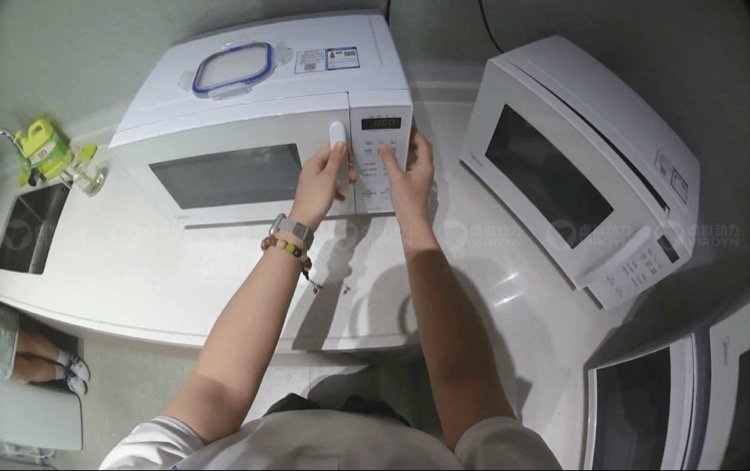
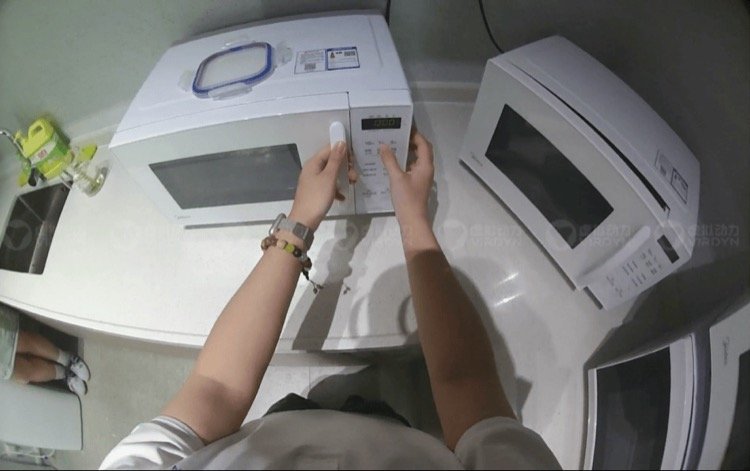
Egocentric data collection records activities from the participant’s viewpoint. It captures hands, nearby objects, and workspace changes during real operations.
This perspective is particularly relevant when studying manipulation and everyday task sequences.
Ego4D demonstrates the breadth of first-person research data: its published dataset includes 3,670 hours of daily-life video across 74 locations in nine countries. Its benchmarks include hand–object manipulation and activity forecasting.
The lesson is not simply that scale matters. Scenario diversity and clearly defined evaluation tasks matter too.
Human Demonstrations Are Not Robot Trajectories
A person and a robot differ in reach, joints, sensing, and control.
A video showing successful human manipulation does not necessarily contain robot joint positions, gripper commands, or executable end-effector trajectories.
Depending on the training approach, additional pose estimation, retargeting, robot demonstrations, or action labeling may be necessary.
Open X-Embodiment illustrates a complementary approach: its published work assembles experience from 22 robotic embodiments and investigates learning across robot platforms. Human video and robot trajectory data serve related, but distinct, purposes.

A Practical Data Annotation Workflow
A reliable workflow begins before annotation starts.
1. Define the Target Capability
Specify what the system should accomplish.
“Understand warehouse work” is too broad. “Identify the target carton and recognize successful placement on a designated shelf” creates a clearer data requirement.
Document the deployment environment, expected inputs, failure conditions, and evaluation method.
2. Design Scenarios and Collection Coverage
Create a collection matrix covering relevant variation:
1. Object categories and physical properties.
2. Workspace layouts.
3. Lighting and background conditions.
4. Participant variation.
5. Task success, failure, and recovery.
6. Occlusion and difficult viewing angles.
Separate representative conditions from deliberately challenging cases.
3. Specify the Annotation Schema
Define labels, relationships, temporal boundaries, and uncertainty rules.
For “pick up,” specify whether the event begins at hand movement, first contact, or object motion. State when it ends.
Include examples and counterexamples. Provide an escalation path for situations the guidelines do not cover.
4. Run a Pilot Before Scaling
Use a small, representative batch to test capture settings, annotation instructions, export structure, and quality checks.
Have the model team inspect the output. A technically valid dataset can still be unsuitable for the intended training pipeline.
Resolve disagreements before producing the full volume.
5. Combine Automation with Human Review
Automated tools can propose boxes, tracks, masks, or preliminary labels.
Human reviewers should address ambiguous boundaries, occluded interactions, task outcomes, and unusual events. Review intensity should reflect the consequences of errors, not just annotation complexity.
6. Validate and Deliver
Check labels, media integrity, synchronization, metadata, and dataset partitions.
Delivery should include a manifest, schema documentation, quality report, known limitations, and version identifier—not just folders of media files.
How to Measure Annotation Quality
“High accuracy” is incomplete without a metric, sample, and acceptance rule.
Different annotation tasks require different checks.
| Quality dimension | Example check |
|---|---|
| Object localization | Intersection-over-union against reviewed references |
| Tracking | Identity switches and track continuity |
| Action segmentation | Boundary error or temporal overlap |
| Sensor synchronization | Measured timestamp offsets |
| Completeness | Missing labels and required metadata |
| Consistency | Agreement between independent annotators |
Agreement alone does not establish correctness. Annotators can consistently apply a mistaken interpretation.
A stronger process combines independent review, adjudicated reference examples, and checks against the intended model task.
For procurement, prioritize traceability: can each delivered sample be connected to its collection conditions, processing history, annotation version, and review status?
Risk-management guidance such as the NIST AI Risk Management Framework also emphasizes evaluation and documentation throughout the system lifecycle.
An Illustrative Warehouse Annotation Plan
Consider a project intended to recognize whether a person places the correct package in the correct bin. This is an example workflow, not a reported customer result.
A useful annotation plan might include:
1. Assign stable identities to packages and bins.
2. Record the instruction associated with each attempt.
3. Mark reaching, grasping, transport, and release intervals.
4. Label the destination and observed outcome.
5. Flag occlusion, ambiguous identity, and failed attempts.
The acceptance process should test difficult cases, such as visually similar packages and temporary hand occlusion.
This approach produces more useful supervision than labeling every visible object without considering the task.
Combining Real-World and Synthetic Data
Real-world recordings capture physical interactions and operating variability. Synthetic environments can support controlled changes to layouts, appearances, viewpoints, and task configurations.
However, synthetic data does not automatically eliminate the gap between simulation and deployment.
Geometry, lighting, materials, contact behavior, and sensor characteristics can differ.
A practical approach is to:
1. Establish a real-world evaluation set.
2. Identify missing or weakly represented conditions.
3. Generate targeted synthetic examples.
4. Compare performance before and after their introduction.
5. Investigate gains and regressions by scenario.
Keep synthetic origin and generation settings documented. Training teams should know which samples are simulated and how they were produced.
How Virdyn Supports AI Data Production
Virdyn, also known as VDEgo, provides data solutions focused on embodied AI, robotics training, and computer vision.
Its described service scope connects requirements analysis, scenario design, task planning, collection, processing, annotation, quality inspection, and delivery.
Egocentric Data Collection
Virdyn’s VDEgo-C2 wearable binocular camera system is designed to record real people performing tasks in real environments.
The supplied product information describes stereo RGB capture, synchronized IMU data, timestamp recording, camera pose tracking, local storage, and wireless remote control.
Before production, teams should confirm capture settings, calibration procedures, synchronization performance, and pose-output specifications.
Multimodal Dataset Development
Virdyn’s stated dataset scope includes RGB video, inertial measurements, synchronized records, camera poses, spatial data, body motion, and hand-operation data.
Available service categories include off-the-shelf datasets, custom datasets, and industry-specific collection.
Not every modality should be assumed available in every package. Collection methods, estimation methods, and deliverables should be specified individually.
Processing, Annotation, and Delivery
Virdyn describes support for cleaning, annotation, quality inspection, and common output formats including MP4, AVI, CSV, JSON, and PLY.
These formats serve different purposes: video containers, structured records, and spatial data are not interchangeable.
For VLA or world-model development, buyers should additionally define episode structure, language alignment, action representation, and compatibility with their training pipeline.
Choosing a Data Annotation Partner
Evaluate partners through a representative pilot rather than broad promises.
Ask for:
1. A sample annotation guide and export.
2. A documented review and disagreement-resolution process.
3. Evidence of relevant modality support.
4. Collection consent and data-rights procedures.
5. Access controls, retention rules, and deletion arrangements.
6. A clear approach to scope changes and rework.
Compare cost per accepted, usable sample—not only cost per recorded hour.
For a Virdyn project brief, provide the target task, operating environment, required modalities, label definitions, expected volume, and acceptance criteria. Request a pilot dataset and quality report before committing to full-scale production.

Frequently Asked Questions
What is the difference between data annotation and data labeling?
The terms are often interchangeable. Annotation can also refer to richer structures, including object relationships, temporal boundaries, and multimodal alignment.
Does every AI model require annotated data?
No. Self-supervised and other approaches can learn without manually assigned labels. Annotated data remains useful for targeted training, evaluation, and error analysis.
Can first-person video directly train a robot?
It depends on the learning method. Video can support visual and action understanding, but executable control may require robot-specific action data or additional processing.
What makes a multimodal dataset usable?
Relevant modalities, reliable synchronization, calibration information, consistent schemas, clear rights, and compatibility with the intended training process all matter.
Can automated annotation replace human reviewers?
Automation can reduce repetitive work. Ambiguous interactions, unusual cases, and consequential labels still require an appropriate review strategy.
How much annotated data does a robotics project need?
There is no universal quantity. Start with a representative pilot, evaluate performance on held-out conditions, and expand according to measured gaps.
References
1. iMerit. “What Is Data Annotation? Key Concepts and Use Cases.” Source for the original article’s definitions, annotation categories, workflow, and supplier-selection topics.[imerit]
2. Grauman, K., et al. “Ego4D: Around the World in 3,000 Hours of Egocentric Video.” CVPR, 2022. Source for the published dataset scale, geographic coverage, and first-person benchmark tasks.[openaccess.thecvf]
3. Open X-Embodiment Collaboration et al. “Open X-Embodiment: Robotic Learning Datasets and RT-X Models.” Source for the 22 robotic embodiments and research on cross-embodiment learning.[arxiv]
4. National Institute of Standards and Technology. “Artificial Intelligence Risk Management Framework (AI RMF 1.0).” January 2023. Source for lifecycle evaluation, documentation, and risk-management principles.[nvlpubs.nist]
Hot Tags: Data Annotation Services, AI Data Collection, Data Labeling Services, AI Training Data, Robotics Training Data, Egocentric Data Collection, Multimodal Datasets, Custom AI Datasets, Computer Vision Annotation, Embodied AI Data Solutions
SHARE



