Powering Physical AI with Real-World Ego Datasets

Egocentric vs Synthetic Data for Humanoid Robot Training
Content Menu
● Egocentric Data and Synthetic Data: Understanding the Difference
>> What Is Egocentric Data for Robot Training?
>> What Is Synthetic Data for Humanoid Robots?
● Egocentric Data vs Synthetic Data: Six Practical Comparisons
>> 1. Realism and Physical Interaction
>> 2. Scale and Scenario Coverage
>> 3. Annotation and Ground Truth
>> 5. Cost and Development Time
>> 6. Reproducibility and Debugging
● What Published Research Actually Demonstrates
>> Egocentric Demonstrations Can Support Manipulation Learning
>> Synthetic Trajectories Can Accelerate Data Production
● An Overlooked Issue: The Action-Supervision Gap
● A Practical Hybrid Training Workflow
>> Step 1: Define the Deployment Task
>> Step 2: Capture Representative Human Demonstrations
>> Step 3: Establish a Robot Baseline
>> Step 4: Expand Specific Gaps Synthetically
>> Step 5: Compare Data Mixtures Fairly
>> Step 6: Validate on Unseen Physical Conditions
● How Virdyn Supports a Hybrid Data Strategy
● Which Data Source Should You Prioritize?
● Build a Dataset Around Your Robot’s Next Bottleneck
>> Is egocentric data better than synthetic data for humanoid training?
>> Can synthetic data replace real-world robot testing?
>> Does first-person video contain everything needed for a VLA model?
>> What is domain randomization?
>> What should buyers request before commissioning a dataset?
Egocentric data vs synthetic data for humanoid robot training is not simply a choice between real footage and virtual environments. It is a decision about what a robot needs to learn, which training signals are available, and how reliably those signals transfer into physical action.
Egocentric data captures activities from a first-person perspective. Synthetic data creates training examples through simulation, rendering, or generative models. Both can support humanoid development, but they solve different problems.
My recommendation is a hybrid strategy: use real-world demonstrations to ground behavior, synthetic data to expand coverage, and physical robot testing to verify performance. The key is understanding where each source helps—and where it leaves gaps.
Egocentric Data and Synthetic Data: Understanding the Difference
What Is Egocentric Data for Robot Training?
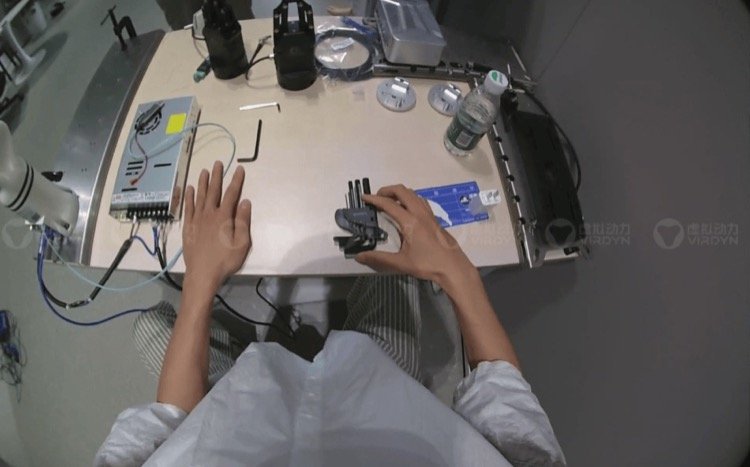
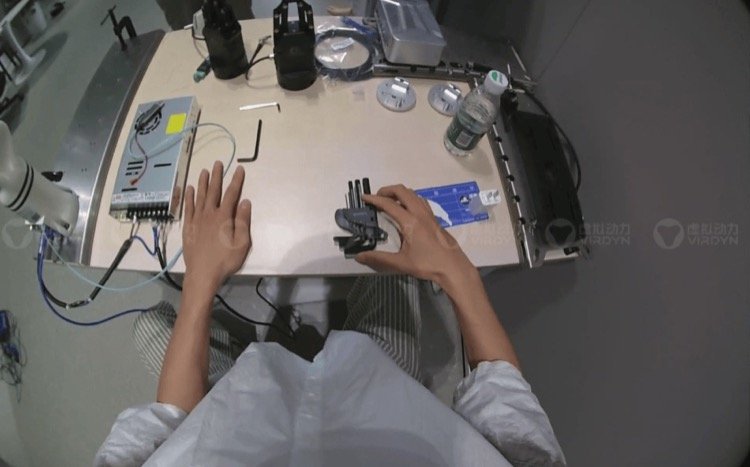
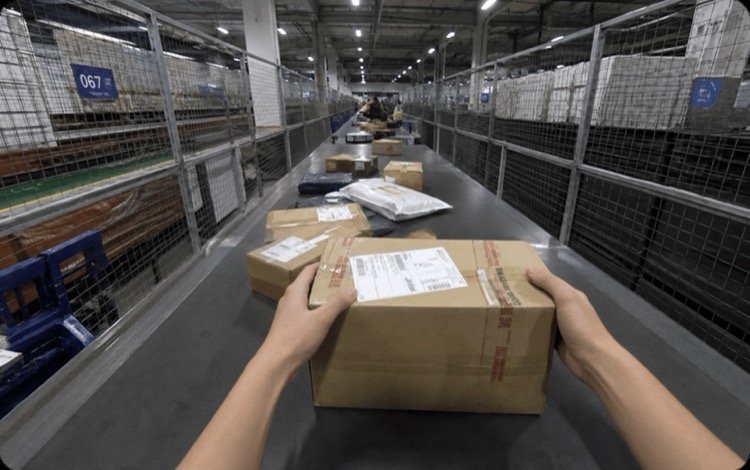
Egocentric data records the world from the viewpoint of an acting person or robot. For human demonstrations, wearable cameras capture hands, objects, and task sequences as activities unfold.
A multimodal collection system may combine:
-
First-person RGB video.
-
Synchronized IMU measurements.
-
Camera calibration and estimated pose.
-
Hand trajectories and body movements.
-
Task descriptions and action timestamps.
Not every dataset contains every modality. Human first-person video also does not automatically provide robot joint commands, grip forces, or executable actions.
Its value lies in showing how tasks happen naturally: where a person reaches, how objects move, and how actions connect across a complete workflow. Turning those observations into robot behavior requires additional modeling and alignment.
What Is Synthetic Data for Humanoid Robots?
Synthetic data is generated rather than directly recorded from the target physical interaction.
Three categories matter:
-
Rendered perception data: images with labels such as object positions, segmentation masks, and depth.
-
Physics-based trajectories: simulated robot actions paired with observations and environment states.
-
Generative video and trajectories: model-produced scenarios that may require filtering and action reconstruction.
These categories are not interchangeable. A realistic video may help visual learning without containing physically executable robot actions. NVIDIA’s GR00T-Dreams workflow, for example, processes generated video through an inverse dynamics model to produce action trajectories.
Egocentric Data vs Synthetic Data: Six Practical Comparisons
1. Realism and Physical Interaction
Egocentric capture records real lighting, clutter, occlusion, and human adaptation. It can reveal how workers reposition an object or recover after an unsuccessful attempt.
However, visible contact is not measured contact. Video and IMU alone do not establish fingertip force, friction, or tactile state.
Simulation offers control over those variables, but its usefulness depends on model accuracy. Friction, deformation, and collisions can differ from reality. A visually convincing scene is therefore not proof of physically accurate manipulation.
2. Scale and Scenario Coverage
Real-world collection requires people, equipment, permissions, and quality checks. Increasing coverage means recruiting additional operators and recording more environments.
Synthetic pipelines can vary object placement, textures, lighting, and selected physical parameters systematically. They make it easier to create repeatable scenario families.
The trade-off is relevance. Thousands of variations around an inaccurate scene can expand a dataset without expanding useful knowledge. Scenario design should follow observed deployment conditions and failure modes.
3. Annotation and Ground Truth
Egocentric footage often needs temporal segmentation, object labeling, hand tracking, and task annotation. Occlusions and motion blur can make those outputs uncertain.
Simulation can expose precise states within its own environment, reducing some manual labeling requirements.
But simulated ground truth describes the simulator—not necessarily reality. Generated video presents another challenge: its labels and inferred trajectories require validation rather than automatic acceptance.
4. Human-to-Robot Transfer
Human demonstrations show useful intentions and action sequences. A person can open a drawer, retrieve an item, and place it in a container naturally.
A humanoid may have different reach, joint limits, grippers, and camera placement. Transferring the demonstration requires more than reproducing the visible movement.
Synthetic environments can represent the target robot directly, making embodiment constraints explicit. Yet that advantage depends on accurate robot and environment models.
Both approaches have transfer gaps: human-to-robot for demonstrations, and simulation-to-reality for virtual training.
5. Cost and Development Time
Neither approach is universally cheaper.
Egocentric costs include recruitment, capture, annotation, privacy handling, and rejected recordings. Synthetic costs include asset creation, simulator integration, compute, filtering, and real-world validation.
I would compare cost per accepted training episode and cost per improvement in deployment performance—not cost per recorded hour alone.
Synthetic generation may reduce marginal production costs once a pipeline works, but substantial setup effort can come first. This is a procurement framework, not a claim that one source always offers better economics.
6. Reproducibility and Debugging
Simulation supports controlled experiments. Teams can repeat a scenario while changing one factor, such as lighting or object mass.
Real-world demonstrations reveal conditions that designers may not anticipate, but exact repetition is harder.
Use synthetic scenarios to isolate suspected causes. Use fresh real-world trials to determine whether the resulting improvement survives outside the development environment. Domain randomization research supports varying simulated conditions, while also recognizing the importance of evaluating transfer.
What Published Research Actually Demonstrates
Egocentric Demonstrations Can Support Manipulation Learning
EgoMimic provides a useful example of human and robot data working together. Its framework combines egocentric human demonstrations, three-dimensional hand tracking, teleoperated robot data, cross-domain alignment, and a shared learning architecture.
The researchers reported improvements over their baselines on three real-world manipulation tasks, alongside generalization to new scenes.
The important lesson is methodological: successful transfer involved aligned multimodal demonstrations and robot data—not simply collecting more wearable-camera footage. Its results should not be treated as proof of unrestricted whole-body humanoid competence.
Synthetic Trajectories Can Accelerate Data Production
NVIDIA reported that GR00T-Dreams generated synthetic training data used in developing GR00T N1.5 in 36 hours, compared with an estimated nearly three months of manual human collection.
That is a vendor-reported comparison for a particular workflow, not a universal productivity guarantee.
The broader lesson is the pipeline: generate candidate behavior, filter outputs, reconstruct actions, and evaluate trained policies. Synthetic scale becomes useful when it produces validated learning signals rather than merely plausible images.
An Overlooked Issue: The Action-Supervision Gap
The most useful question is not “How much video do we have?” It is “What can the model learn from each episode?”
For a vision-language-action model, visual observations and instructions must connect to an appropriate action representation. Human hand movement is informative, but it is not equivalent to robot joint control.
World-model development may prioritize predicting future observations or states. Robot policy training additionally needs behavior that can be executed by the target hardware.
Before buying either dataset, request:
-
A sample episode and complete schema.
-
Action definitions and coordinate conventions.
-
Calibration and synchronization information.
-
Annotation confidence and provenance.
-
A clear explanation of missing modalities.
This checklist is a proposed purchasing framework, informed by the alignment and action-reconstruction requirements visible in EgoMimic and GR00T-Dreams.
A Practical Hybrid Training Workflow
Step 1: Define the Deployment Task
Describe the intended behavior precisely.
“Warehouse manipulation” is too broad. “Pick rigid containers from a shelf and place them into designated bins” provides a workable starting point.
Specify object ranges, camera viewpoints, workspace constraints, and acceptable outcomes.
Step 2: Capture Representative Human Demonstrations
Collect different operators, object arrangements, and execution styles. Include recoveries and unsuccessful attempts when relevant, with clear outcome labels.
Prioritize meaningful variation rather than repeated footage of an identical successful sequence.
Step 3: Establish a Robot Baseline
Collect target-robot demonstrations or another suitable source of robot action supervision.
This baseline helps distinguish a perception problem from an embodiment or control problem.
Step 4: Expand Specific Gaps Synthetically
Generate variations around observed weaknesses: unfamiliar layouts, partial occlusion, changed illumination, or selected dynamics.
Avoid maximizing variation without checking whether it remains relevant and physically credible.
Step 5: Compare Data Mixtures Fairly
Test real-data, synthetic-data, and mixed-data configurations with documented training budgets.
Track success rate, intervention frequency, completion time, and failure severity. There is no universal mixing ratio.
Step 6: Validate on Unseen Physical Conditions
Reserve operators, objects, and environments for evaluation. Avoid splitting adjacent frames from the same recording across training and testing.
These steps are a recommended experimental design rather than a published universal recipe. They combine the complementary roles of real demonstrations, synthetic expansion, and physical validation.
How Virdyn Supports a Hybrid Data Strategy
Virdyn’s VDEgo offering addresses the real-world collection side through wearable first-person capture and multimodal data workflows.
Its published materials describe the binocular VDEgo-C2, synchronized visual and IMU capture, and offline trajectory processing. These capabilities can support the collection of human manipulation demonstrations for subsequent processing and learning.
For procurement, distinguish capture capability from final dataset deliverables. Camera pose, hand tracking, three-dimensional reconstruction, and robot action labels may require different processing stages.
A useful project specification should establish:
-
Required modalities and collection environments.
-
Synchronization and calibration acceptance criteria.
-
Annotation scope and quality checks.
-
Consent, privacy, and permitted data uses.
-
Delivery schemas and sample validation.
Virdyn can be positioned as a partner for building the real-world foundation of a broader pipeline. Any simulation, annotation, or model-ready delivery requirements should be confirmed explicitly in the project scope rather than inferred from camera specifications.
Which Data Source Should You Prioritize?
Prioritize egocentric collection when the main uncertainty concerns human workflows, task sequencing, or authentic operating conditions.
Prioritize synthetic generation when you have a reliable environment model and need controlled variation, repeatable experiments, or additional scenario coverage.
Prioritize robot-specific supervision when failures arise from grasp execution, joint constraints, or control—not missing visual variety.
For most development programs, the practical objective is complementary coverage. Choose the next dataset according to the bottleneck it can resolve, then verify its contribution on the physical robot.
Build a Dataset Around Your Robot’s Next Bottleneck
Bring Virdyn your target task, robot configuration, operating environment, and required modalities. Request a pilot collection with representative sample episodes and agreed quality criteria before scaling.
The objective is not the largest archive. It is a traceable dataset that helps your team diagnose failures, improve behavior, and demonstrate measurable progress.

Frequently Asked Questions
Is egocentric data better than synthetic data for humanoid training?
Neither is universally better. Egocentric data grounds learning in real activities. Synthetic data supports controlled expansion. Their value depends on the task, available action supervision, and demonstrated transfer to the robot.
Can synthetic data replace real-world robot testing?
No training-data source establishes deployment reliability by itself. Simulation differs from physical environments, so policies intended for real robots require physical evaluation under relevant operating conditions.
Does first-person video contain everything needed for a VLA model?
Not necessarily. Video may lack instructions, calibrated geometry, or suitable action labels. EgoMimic’s alignment process illustrates why human observations and robot supervision must be connected deliberately.
What is domain randomization?
Domain randomization varies simulated properties, such as textures, lighting, or dynamics, to reduce reliance on a narrow virtual environment. It can support transfer, but cannot guarantee that an inaccurate simulator captures every important physical interaction.
What should buyers request before commissioning a dataset?
Request sample episodes, modality definitions, calibration records, annotation guidelines, provenance, and acceptance criteria. Specify whether the deliverable is raw capture, processed observations, or action-supervised training data. This is a recommended checklist based on the distinctions discussed above.
References
1. Kareer, S., et al. “EgoMimic: Scaling Imitation Learning via Egocentric Video.” Research project and accompanying paper, 2024. Supports the discussion of human–robot alignment, joint training, and manipulation experiments. https://egomimic.github.io/
2. NVIDIA. “Enhance Robot Learning with Synthetic Trajectory Data Generated by World Foundation Models.” June 16, 2025. Explains generation, filtering, inverse dynamics, and synthetic trajectory training. https://developer.nvidia.com/blog/enhance-robot-learning-with-synthetic-trajectory-data-generated-by-world-foundation-models/
3. NVIDIA. “NVIDIA Powers Humanoid Robot Industry With Cloud-to-Robot Computing Platforms for Physical AI.” May 18, 2025. Source of the attributed 36-hour production comparison. https://nvidianews.nvidia.com/news/nvidia-powers-humanoid-robot-industry-with-cloud-to-robot-computing-platforms-for-physical-ai
4. Tobin, J., et al. “Domain Randomization for Transferring Deep Neural Networks from Simulation to the Real World.” 2017. Supports the explanation of randomized synthetic visual training. https://arxiv.org/abs/1703.06907
5. Weng, L. “Domain Randomization for Sim2Real Transfer.” May 5, 2019. Technical overview of visual variation, dynamics variation, and transfer limitations. https://lilianweng.github.io/posts/2019-05-05-domain-randomization/
6. Tobin, J. “Beyond Domain Randomization.” Robotics: Science and Systems presentation, 2019. Discusses difficult contact interactions and iterative real-world evaluation. http://josh-tobin.com/assets/pdf/BeyondDomainRandomization_Tobin_RSS19.pdf
7. Virdyn. “Products” and “Scaling Egocentric Video Data Collection: Bridging the Gap Between Vision and Action.” Company descriptions supporting the VDEgo-C2 and capture-workflow discussion; these are manufacturer statements, not independent performance verification. https://www.virdynm.com/news/scaling-egocentric-video-data-collection-bridging-the-gap-between-vision-and-action/ | https://www.virdynm.com/products/
Hot Tags: Egocentric Data Collection, Synthetic Data Generation, Humanoid Robot Training, Robotics Training Data, Embodied AI Datasets, Multimodal Data Collection, AI Data Annotation Services, Custom AI Datasets, VLA Training Data, Sim To Real Transfer
SHARE



