Powering Physical AI with Real-World Ego Datasets


Human Data Labeling for Embodied AI and Robotics Training
Human data labeling helps embodied AI teams turn real-world observations into meaningful training signals. For robotics, however, identifying objects is only the beginning. A useful dataset must also explain what happened, when it happened, how objects changed, and whether an attempted action succeeded.
That makes human data labeling part of a larger engineering process: collecting relevant demonstrations, synchronizing sensors, defining annotations, checking quality, and delivering reproducible datasets.
Virdyn, through its VDEgo offering, brings together egocentric data collection, multimodal dataset development, annotation, and capture hardware. For teams developing robots, Vision-Language-Action models, or world models, the practical question is not simply how much data to acquire. It is how to make that data useful for a clearly defined learning objective.

Why Human Data Labeling Matters for Embodied AI
A conventional image classifier may need to distinguish a cup from a bowl. A service robot faces a more demanding problem: identify the cup, understand an instruction, approach it, establish a stable grasp, and place it safely.
Training data therefore needs to represent relationships across perception, language, movement, and outcomes.
Human reviewers help interpret details that automated systems can miss:
-
Whether a hand actually contacts an object.
-
Whether an object slips during manipulation.
-
Whether a task finishes successfully.
-
Whether an instruction matches the recorded activity.
-
Whether an apparent error is intentional recovery behavior.
From a dataset-design perspective, the important distinction is between visible motion and meaningful action. “The hand moved left” describes movement. “The operator repositioned the container after a failed grasp” describes task context.
Neither annotation is universally better. The appropriate label depends on what the model must learn.
Where Automation Fits
Automated tools can propose object tracks, action segments, masks, and descriptions. Human reviewers can then correct uncertain outputs and resolve ambiguous examples.
This hybrid approach should be evaluated rather than assumed effective. A fast pre-labeling system creates little value if reviewers spend longer repairing its suggestions than labeling from scratch.
A pilot should measure accepted annotations per reviewer hour, correction frequency, and performance on difficult examples.
What Egocentric Data Adds to Robot Training
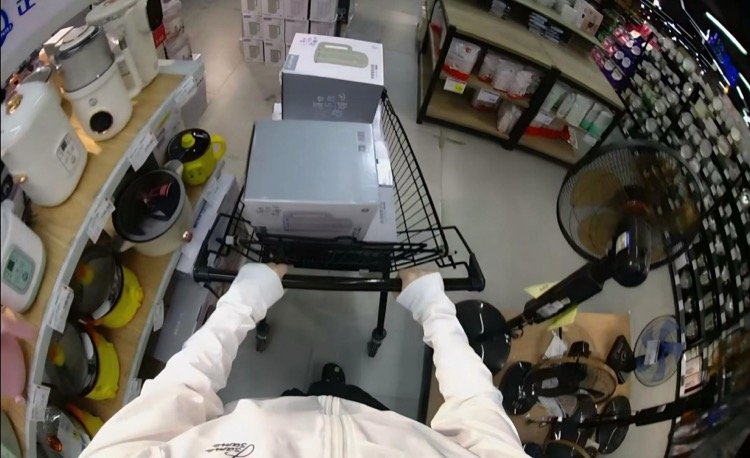
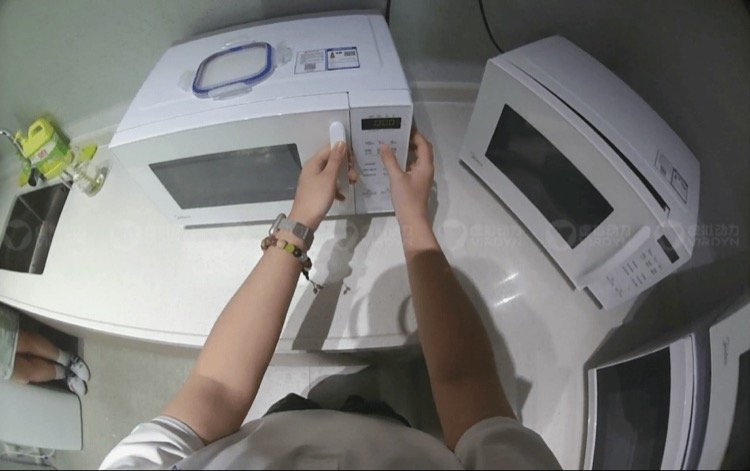
Egocentric data collection records activity from the participant’s first-person viewpoint. This perspective can reveal hand-object interactions and manipulation sequences that distant cameras may obscure.
The Ego4D research project illustrates the scale and diversity possible with this approach: its published paper describes 3,670 hours of everyday activity across 74 locations in nine countries.
For commercial projects, however, diversity must be purposeful. A warehouse dataset may need different shelving heights, packaging materials, lighting conditions, and picking errors—not simply more recordings of the same successful action.
Human Demonstrations Are Not Robot Commands
First-person human video can support activity understanding, representation learning, and task decomposition. It does not automatically provide executable robot actions.
Human hands and robot grippers differ in geometry, reach, sensing, and control.
Depending on the training approach, additional robot demonstrations, teleoperation recordings, action representations, or adaptation methods may be necessary.
This distinction matters when specifying deliverables. A video collection suitable for visual pretraining is not necessarily sufficient for training a manipulation policy.
Design Multimodal Datasets Around the Learning Objective
Before recording begins, define the model’s inputs, expected outputs, and evaluation tasks.
A Vision-Language-Action model connects observations and language with actions. A world model learns aspects of how an environment evolves. Their data requirements can overlap, but they are not interchangeable.
| Data component | Potential training value | Essential validation question |
|---|---|---|
| RGB video | Objects, scenes, interactions | Are important details visible? |
| IMU measurements | Capture-device motion | Are units and timestamps documented? |
| Camera pose | Viewpoint changes and spatial relationships | What coordinate frame and estimation method apply? |
| Hand or body motion | Demonstration structure | How were trajectories obtained and checked? |
| Language annotations | Instructions and action descriptions | Do descriptions match the episode? |
| Task outcomes | Success, failure, and recovery | Is the outcome definition reproducible? |
Not every project needs every modality. Collecting unnecessary channels increases processing and review costs.
Equally, hardware availability does not guarantee every derived output. Camera pose, hand trajectories, and three-dimensional reconstructions may require additional processing, calibration, or validation.
Synchronization Is Part of Data Quality
A video frame and an IMU measurement are only useful together when their temporal relationship is understood.
Specify a shared timestamp convention, recording start behavior, missing-sample handling, and acceptable alignment error.
Keep these requirements task-specific. Fast manipulation may demand tighter alignment than coarse activity classification.

A Practical Human Data Labeling Workflow
A reliable workflow starts before annotation and continues after delivery.
1. Define Success Before Defining Labels
Write a short acceptance brief covering:
-
Target environment and deployment task.
-
Required observations and annotations.
-
Definitions of success, failure, and uncertainty.
-
Coverage requirements.
-
Evaluation procedures.
Avoid goals such as “high-quality robot data.” They are too broad to guide collection or resolve disputes.
2. Build a Scenario and Task Matrix
Break the intended environment into meaningful variations.
For warehouse picking, these might include rigid cartons, flexible bags, reflective packaging, partial occlusion, clutter, and failed grasps.
Include recovery sequences where relevant. A dataset containing only clean successes may omit the conditions that matter during deployment.
3. Run a Small Capture Pilot
Record representative tasks before scaling.
Inspect hand visibility, motion blur, camera stability, sensor alignment, and whether complete task outcomes remain in view.
The pilot should also test annotator understanding. If reviewers repeatedly disagree about action boundaries, revise the instructions before producing thousands of labels.
4. Create an Annotation Handbook
A useful handbook combines definitions with examples.
For temporal actions, explain exactly when each action begins and ends. For contact labels, distinguish visible contact from inferred contact. For outcomes, define what constitutes completion.
Provide an “uncertain” option and an escalation route. Forcing a definitive answer when evidence is missing creates false precision.
5. Combine Automated Assistance With Human Review
Use automation where its proposals are consistently helpful.
Route ambiguous, safety-relevant, or unusual examples to experienced reviewers. Periodically inspect apparently easy examples too; confidence scores can miss systematic errors.
Resolve repeated disagreements through guideline updates, not just individual corrections.
6. Validate the Delivered Package
Check media files, annotation schemas, timestamps, identifiers, coordinate systems, and documentation.
Then test ingestion in the customer’s actual training pipeline.
A package is not training-ready merely because its files open successfully.
Measure Quality Beyond a Single Accuracy Score
A claim such as “99% annotation accuracy” is incomplete without a defined metric, sample, and review method.
Different annotation tasks require different checks.
| Quality dimension | Suggested check | What it reveals |
|---|---|---|
| Spatial labeling | Mask or box overlap against adjudicated examples | Localization consistency |
| Temporal labeling | Boundary error and segment overlap | Action-timing consistency |
| Sensor integrity | Missing samples and alignment checks | Multimodal usability |
| Scenario coverage | Delivered episodes against the task matrix | Missing conditions |
| Dataset separation | Participant, session, and location overlap | Potential evaluation leakage |
| Traceability | Versioned guidelines and review records | Reproducibility |
These are proposed acceptance practices, not universal performance guarantees.
Evaluate Model Impact Separately
Annotation quality and model performance are related, but they are not identical.
A consistently labeled dataset can still be poorly matched to deployment. Conversely, a model improvement may reflect changes in architecture or training rather than annotation alone.
Use held-out scenarios and controlled comparisons where practical. Track task completion, recovery behavior, and relevant safety failures—not only perception metrics.
Combine Real-World and Synthetic Data Carefully
Simulation can help generate controlled variations, repeat difficult scenarios, and provide labels that are expensive to obtain manually.
Real-world recordings reveal details that simulated environments may simplify, including reflections, deformable materials, motion blur, and unexpected human behavior.
The useful question is not which source should replace the other. It is which learning gaps each source can address.
A practical approach is to:
-
Establish performance on representative real-world tasks.
-
Identify specific coverage gaps or recurring failures.
-
Generate targeted simulated variations.
-
Validate improvements on separate real-world examples.
Adding synthetic volume alone does not demonstrate that the simulation-to-reality gap has narrowed.
An Illustrative Warehouse Dataset Brief
Consider a team developing a robot that transfers packaged products from shelves into order bins.
An initial brief might request “videos of picking.” A stronger brief defines object categories, shelf layouts, grasp challenges, instructions, and completion criteria.
Annotations could include approach, contact, grasp, lift, transfer, release, and recovery. Labels should distinguish a successful placement from dropping an item near the bin.
Evaluation recordings should include unfamiliar packaging and separate capture sessions.
This is an illustrative planning example, not a reported Virdyn customer result. Its purpose is to show how task design converts recording activity into a measurable dataset specification.
How Virdyn Supports the Data Production Lifecycle
According to the supplied company brief, Virdyn provides requirements analysis, scenario design, task planning, first-person collection, processing, annotation, quality inspection, and delivery.
Its proposed application areas include robotics, industrial automation, logistics, smart homes, retail, and laboratory environments.
Egocentric Capture With VDEgo-C2
VDEgo describes its VDEgo-C2 as a wearable collection device integrating binocular RGB cameras and an IMU for embodied AI research and development.
The supplied brief also identifies timestamp recording, local storage, wireless control, and camera-pose capabilities.
Before procurement, request current specifications and representative recordings. Confirm calibration procedures, operating constraints, and which outputs are recorded directly versus computed afterward.
Custom and Off-the-Shelf Datasets
An off-the-shelf dataset can support initial experimentation when its tasks, permissions, and formats fit the project.
Custom collection becomes more relevant when deployment depends on proprietary objects, unusual environments, or tightly specified workflows.
Virdyn’s supplied offering includes both approaches, with delivery formats such as MP4, AVI, CSV, JSON, and PLY where applicable.
File extensions alone do not establish compatibility. Buyers should also request schemas, sample loaders, metadata definitions, and licensing terms.
Privacy and Commercial Readiness
First-person recording may capture faces, screens, documents, and confidential processes.
Before collection, agree on participant permissions, restricted areas, de-identification, access controls, retention, and deletion procedures.
Commercial readiness also requires clear rights to use the delivered data for the intended training and deployment activities.
Start With a Dataset Pilot
The strongest purchasing decision begins with evidence from a representative sample—not a promise about total recording hours.
Ask Virdyn to scope a pilot around your target task, required modalities, annotation definitions, and acceptance checks.
Request a sample episode, annotation package, quality report, and ingestion test before scaling. This gives engineering and procurement teams a shared basis for judging whether the proposed data infrastructure fits the project.
Frequently Asked Questions
What is human data labeling for embodied AI?
It is the human-guided process of assigning meaningful annotations to observations, actions, instructions, and outcomes so models can learn task-relevant relationships.
Can first-person video alone train a robot?
It can support perception and learning from demonstrations, but executable robot control may require additional action data, robot-specific training, or adaptation.
Which labels are most useful for manipulation tasks?
Common options include object identity, hand-object contact, action boundaries, instructions, and outcomes. The right combination depends on the model and evaluation task.
Should every annotation receive expert review?
Not necessarily. A risk-based process can prioritize difficult examples, while representative sampling checks routine work for systematic errors.
Are synthetic datasets a replacement for real recordings?
Not automatically. Their value should be tested against the target task, with separate real-world evaluation used to assess transfer.
What should buyers request before ordering a large dataset?
Request a representative sample, annotation handbook, modality specifications, licensing terms, quality criteria, and a successful ingestion test.
References
1. iMerit — Human Data Labeling for Successful AI. Original article used as the starting point for the discussion of domain expertise, human review, and hybrid labeling workflows. Its generalized performance percentages are not reused here.
2. Grauman, K., et al. — Ego4D: Around the World in 3,000 Hours of Egocentric Video. Research paper, first submitted in 2021. Source for the published dataset scale and geographic coverage.
3. Open X-Embodiment Collaboration — Open X-Embodiment: Robotic Learning Datasets and RT-X Models. Project resource describing standardized robot datasets and cross-embodiment learning; background for the distinction between human video and robot trajectories.
4. VDEgo — Egocentric Data Collection & AI Dataset Provider. Brand-published source for dataset services and the VDEgo-C2’s binocular RGB and IMU positioning. Product statements should be verified during technical evaluation.
5. Virdyn — Products. Brand-published overview of VDEgo first-person capture devices and their intended applications.
Hot Tags: AI Data Labeling Services, AI Data Collection Services, Data Annotation Services, AI Training Data, Robotics Training Data, Egocentric Data Collection, Multimodal Datasets, Custom AI Datasets, Embodied AI, Synthetic Data Generation
SHARE